
This page has been translated from Japanese. If anything is unclear, please get in touch.
Autumn region guide

Chugoku in Autumn

Setting the Scene

General Feeling of the prefecture

Autumn is a good season in Chugoku, not as dramatic as the foliage displays further north in Tohoku or the alpine areas of Chubu, but consistent and pleasant across a region that handles the season without a great deal of fuss. Temperatures ease off from the summer heat through September and October settles into the kind of crisp, clear days that make being outside comfortable and easy. The foliage arrives through November, working its way across the mountain interior and down into the valleys and coastal areas at a pace that extends the season across several weeks rather than concentrating it into a single peak window.

The San'yo and San'in coasts respond to autumn differently, much as they do in every season. The southern coast stays warmer longer into autumn and the foliage arrives later, while the San'in side cools more quickly and sees earlier colour in the hills and forests that back the coastline. The mountain interior between the two coasts tends to produce the strongest autumn colour in the region, and the rural valleys and forested ridgelines that run through Shimane, Tottori, and inland Hiroshima are worth seeking out for travellers who want foliage without crowds. These areas see limited tourist traffic even at the height of autumn and the experience is accordingly more relaxed.
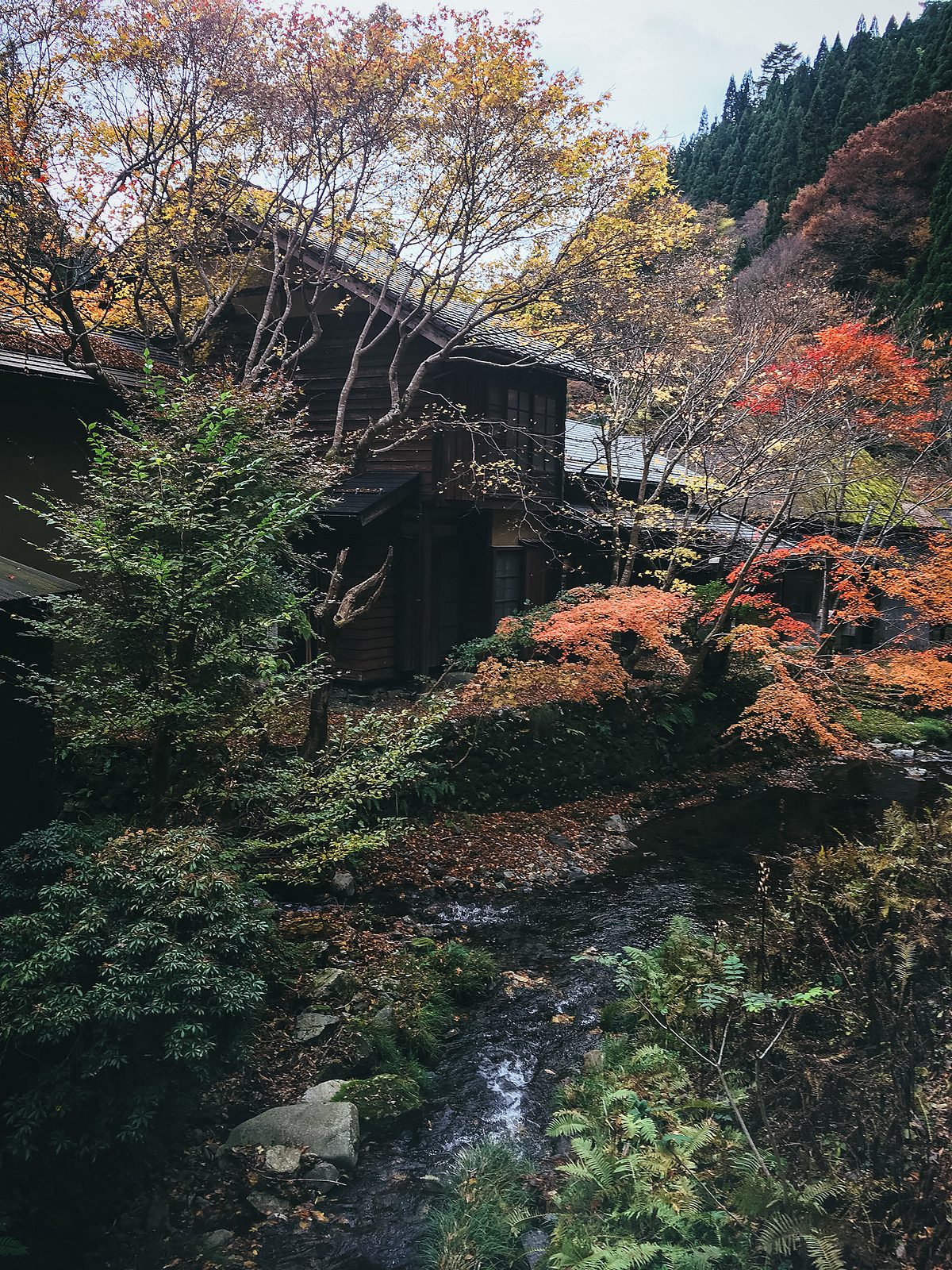
Early autumn colour beside a mountain stream in Chizu, Tottori

Clothing through autumn follows the standard layering approach. October is comfortable in a mid layer for most of the region, with a warmer coat becoming useful by November particularly on the San'in coast where the Japan Sea weather turns cooler and more unpredictable as winter approaches. The season is largely dry and settled through October which makes it reliable for travel, though November brings more variable conditions especially to the north facing coast.
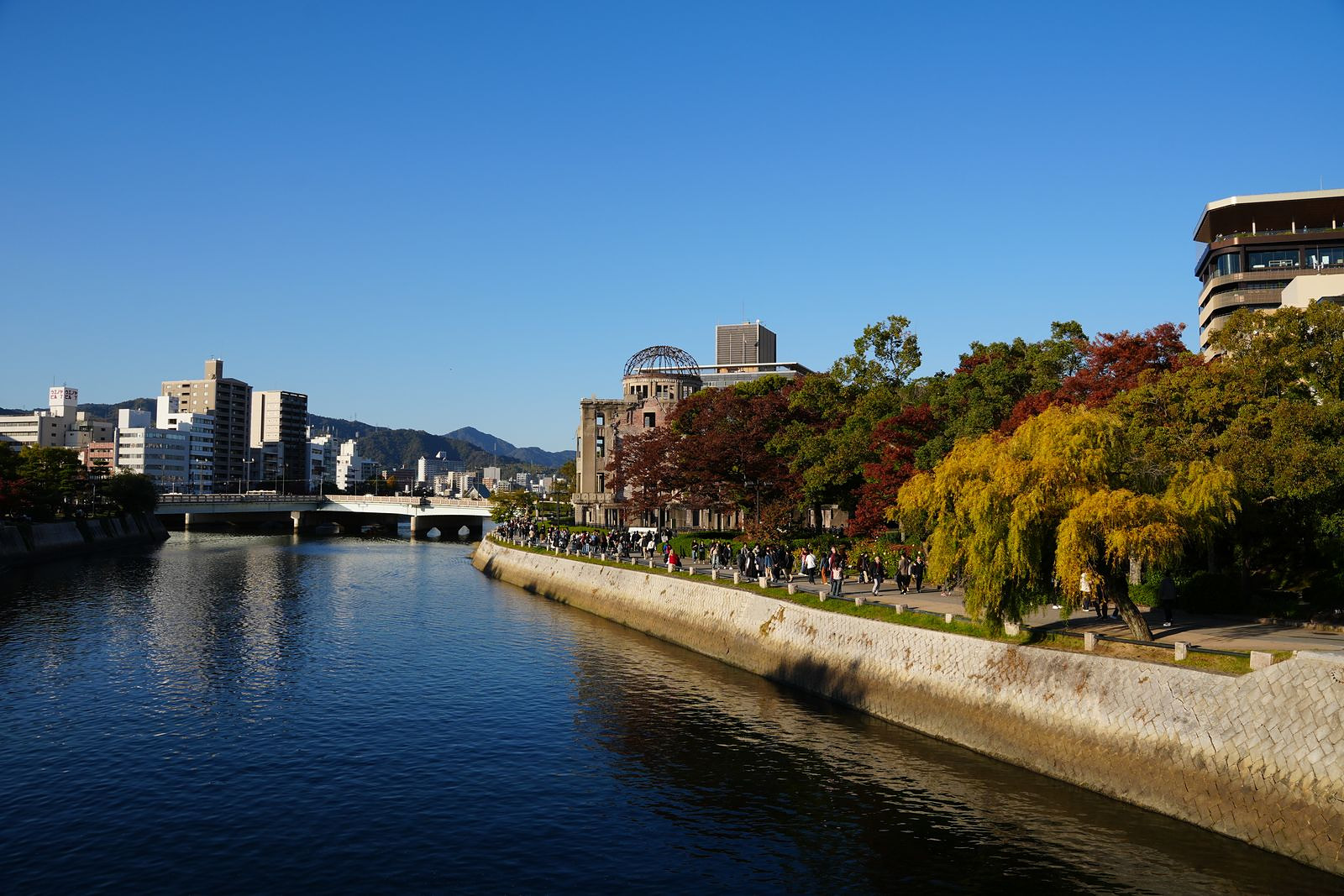
Autumn trees along the river at Hiroshima Peace Memorial Park

Chugoku stays quiet through autumn relative to the rest of Japan. The major sites in Hiroshima and along the Seto Inland Sea draw their usual visitors but the wider region carries none of the booking pressure that defines autumn in Kansai or the more celebrated foliage destinations further north. It is an easy region to travel in at this time of year, availability is good, the weather is cooperative for most of the season, and the autumn colour, while understated compared to some regions, is genuine and worth experiencing on its own terms.

Beyond the capital

Exploring the Chugoku Region

Autumn in Chugoku is a season of gorges, historic gardens, and mountain foliage that reward exploring the region's interior and less visited corners as much as its celebrated coastal landmarks. The colour change works through the mountain ranges of the interior through October and the combination of the volcanic peaks of the Tottori highlands, the limestone gorges of inland Hiroshima, and the carefully maintained garden landscapes of Shimane and Okayama gives the season a geographic variety that makes autumn one of the most rewarding times to move slowly through the region.

Daisen · Tottori

Mount Daisen (大山)

A sacred volcano in western Tottori, its beech forests and the temple town of Daisenji turning colour from late October.

Mount Daisen (大山) in western Tottori Prefecture is the tallest mountain in the Chugoku region at 1,729 metres and is nicknamed "Hōki Fuji" for its Fuji like profile when seen from the south, sitting at the centre of Daisen-Oki National Park. The mountain has been a centre of Shugendo mountain worship for over 1,300 years, with Daisenji Temple at the base founded in the Yoro era of the early 8th century by the priest Kinren and once holding up to 160 subtemples and 3,000 monks at its Heian period peak. From the temple a stone paved approach of about 700 metres, laid on Kansei era foundations of the 1790s and signposted as the longest path of its kind in Japan, climbs between cedars to the inner shrine of Ogamiyama Jinja, and around 33 Jizo statues stand along it and on the old roads below, among them one raised in 1839 for the victims of a famine, one given by a warrior in thanks for a recovery, and one for those lost on the mountain, so that the walk up doubles as a Jizo pilgrimage with the leaves coming down over it. The slopes hold one of the largest beech forests in western Japan, and the colour arrives by elevation rather than all at once. It starts on the upper slopes in early October and works downward, with late October to early November the usual peak around Daisenji, the inner shrine and Masumizu Highland, and there is a second turn in mid to late November when the first snow caps the summit above the colour still holding at the foot. In 2025 the lower slopes kept their best colour into the second week of November. The Daisen Parkway loop road circles the mountain through the beech forest with viewpoints at Kagikake Pass and Kimendai looking up at the South Face of the peak, where the contrast between rocky cliff and gold forest is the defining autumn image. The hiking summit is Misen at 1,709 metres (the true summit Kengamine has been closed due to rockslides), reached by the 5.5 hour Natsuyama Trail round trip from Daisenji. Daisenji Temple is around 50 minutes by Nihon Kōtsū bus from JR Yonago Station.

General information
AddressDaisen, Saihaku District, Tottori 689-3318
AccessFrom Yonago Station, a Nikko bus to the Daisenji stop, around 50 minutes
EntryMountain and trails free, Daisenji main hall ¥300 for adults and ¥200 for children
HoursOpen at all hours, the temple hall in daylight
Phone+81 859 52 2158
Official infoDaisen tourism site
Akiota · Hiroshima

Sandankyo Gorge (三段峡)

A 16 kilometre gorge of waterfalls and clear pools west of Hiroshima, walked along a riverside trail at its best in early November.

A walk from the Sandankyo Front Gate to the Kurobuchi pool along the Shibaki River in northwestern Hiroshima Prefecture takes around 50 minutes one way along the 2.7 kilometre paved gorge path, with the option of a small wooden ferry across the emerald green pool to the Kurobuchi-so tea house for freshly grilled salmon and rice balls. The gorge (三段峡) is the only one in western Japan with the National Special Place of Scenic Beauty designation and runs 16 kilometres in total, with five named scenic spots along its length, Kurobuchi, Sarutobi (a 2 metre wide passage between 20 metre cliffs), Nidantaki (a hidden two tiered waterfall accessible only by boat), the namesake 130 metre Sandantaki three tiered falls and Mitsutaki. Maples and other deciduous trees on the gorge walls turn red, orange and gold from late October to late November. The Kurobuchi ferry runs from around mid April to late November, 10:00 to 16:00, Friday to Tuesday with Wednesdays and Thursdays off, at ¥500 return or ¥300 one way, and it stops for bad water. The 14 seat Sarutobi ferry that reaches Nidantaki is suspended, with a small rental boat running in its place on weekends and holidays and daily through the foliage season, so check the Akiota tourism association site for current trail and boat conditions before setting out. Express buses run from Hiroshima Bus Center to Sandankyo Front Gate in around 75 to 80 minutes for ¥1,440 one way.

General information
AddressShiwagi, Akiota, Yamagata District, Hiroshima 731-3813
AccessFrom Hiroshima by bus to the Sandankyo Seimenguchi entrance
EntryFree, with the ferry boat sections charged separately
Hours9:00 to 16:00, ferry boats 10:00 to 15:00, closed December to March
Phone+81 826 28 1800
Shobara · Hiroshima

Taishakukyo Gorge (帝釈峡)

A limestone gorge of caves and natural rock bridges around Lake Shinryu, with colour from late October to early November.

Taishakukyo Gorge (帝釈峡) is an 18 kilometre limestone gorge in northeastern Hiroshima Prefecture, designated a National Place of Scenic Beauty and listed among Japan's 100 Scenic Views, formed by the Taishaku River cutting through a karst plateau over millions of years. The gorge has two main sections, the Upper Taishaku area to the north with the natural arch landmarks, and the Shinryu Lake area to the south, formed by the Taishakugawa Dam in 1924. The maples and other deciduous trees across the gorge turn red and gold from late October into early November. The Upper Taishaku walking path starts at the 8th century Eimyo-ji Temple and runs 2.5 kilometres past the 200 metre Hakuundo limestone cave, the 8 metre Oni-no-Karamon natural rock gateway, and the famous Onbashi (90 metres long, 18 metres wide, 40 metres above the riverbed), one of the three largest natural bridges in the world and a National Natural Monument. Shinryu Lake to the south offers 40 minute sightseeing boat cruises (¥1,500 adults) and kayak rentals from mid March to mid December. From JR Tojo Station on the JR Geibi Line, the Onbashi area is around 20 minutes by taxi.

General information
AddressTojocho Taishakumido, Shobara, Hiroshima 729-5244
AccessFrom JR Tojo Station, around 20 minutes to the Kami-Taishaku area or 10 minutes to Lake Shinryu
EntryFree, with the sightseeing boat on Lake Shinryu charged separately
HoursOpen at all hours along the trail
ParkingTaishaku car parks near the entrances
Yasugi · Shimane

Adachi Museum of Art (足立美術館)

A museum of modern Japanese painting known as much for its meticulously kept gardens, framed by the building like living scrolls.

The Adachi Museum of Art (足立美術館) in Yasugi City in Shimane Prefecture has held the top spot in the American Journal of Japanese Gardening's annual ranking of Japan's best gardens for 23 consecutive years, every year since 2003, and is rated three stars in the Michelin Green Guide, with six different gardens (the Dry Landscape, Moss, White Gravel and Pine, Pond, Juryu-an and the Kikaku Waterfall) viewed primarily from inside the museum building through windows that frame each garden as a living painting. The maples and other deciduous trees in the gardens turn red and gold from late October to mid November, with the surrounding forested mountains as the borrowed scenery backdrop. Founded in 1970 by self made local businessman Adachi Zenko, the museum also holds ~2,000 works of modern Japanese painting, including 120 by Yokoyama Taikan, with the lavish "Autumn Leaves" (1931) brought out each year for the special autumn exhibition. The Rosanjin Hall (opened 2020) houses 120 works by ceramicist and calligrapher Kitaoji Rosanjin. Adult admission is ¥2,500. JR Yasugi Station is around 2.5 hours from Okayama on the JR Hakubi Line Limited Express Yakumo, with a free shuttle bus running twice an hour to the museum.

General information
Address320 Furukawacho, Yasugi, Shimane 692-0064
AccessFrom JR Yasugi Station, a free shuttle bus to the museum, around 20 minutes
EntryAround ¥2,300 adults
Hours9:00 to 17:30, shorter in winter
ParkingFree parking
Phone+81 854 28 7111
Izumo · Shimane

Izumo Taisha (出雲大社)

A great shrine in western Shimane where, in the old tenth lunar month, the gods of Japan are said to gather.

Izumo Taisha (出雲大社) in Izumo City in Shimane Prefecture is often described as Japan's oldest shrine, with records placing it in existence by the early 700s, and is dedicated to Okuninushi no Okami, the deity of nation building and of en-musubi, the tying of good relationships. Worshippers clap four times here rather than the usual two, twice for themselves and twice for a partner present or future. Scale is the shrine's defining feature. The honden main hall stands 24 metres high in the ancient taisha-zukuri style and is designated a National Treasure, and medieval records describing far taller earlier halls were given weight in 2000, when the bases of three bundled pillars nearly three metres across were excavated within the precinct. The great shimenawa rope at the Kagura-den measures around 13.5 metres and weighs about 5 tonnes. The approach runs downhill along the pine lined Matsu no Sando, whose centre lane is kept clear for the gods, past the bronze torii and the hare statues that recall the myth of the white hare of Inaba. Autumn is the shrine's own season, when the tenth lunar month falls in late November and early December and the wooded hills behind the precinct turn while the divine assembly is under way. Entry is free and the grounds open from 6:30am. The Ichibata Electric Railway runs from JR Izumo-shi Station to Izumo Taisha-mae Station in around 25 minutes.

General information
Address195 Taishacho Kizukihigashi, Izumo, Shimane 699-0701
AccessFrom Izumoshi Station by Ichibata bus to Izumo Taisha, or the Ichibata train to Izumotaisha-mae Station
EntryFree
Hours6:30 to 19:00, with seasonal variation
ParkingFree parking
Phone+81 853 53 3100
Autumn moments

Seasonal Experiences and Events in Autumn

Now that you have a sense of how the season runs here, these are the highlights and experiences worth building an autumn visit around.

Prefecture map

Seasonal culture

Seasonal Food & Everyday Atmosphere

Autumn in Chugoku brings some of the region's best seasonal produce and seafood together at the same time. The Seto Inland Sea and the Japan Sea coast both deliver key catches through the season, the mountain interior produces mushrooms and foraged ingredients, and the agricultural areas bring in their harvest. It is a good season to eat across the region and the variety available across its different landscapes is one of Chugoku's quiet strengths.

牡蠣 (Kaki)

Oysters

The Hiroshima season opens as the water cools, when the oysters are smaller and cleaner tasting.

Grilled, fried and raw

Oysters open the Chugoku autumn rather than crown it. Hiroshima grows roughly sixty percent of Japan's oysters in the Seto Inland Sea, and the season starts as water temperatures drop through October, which is when the rafts come in and the shucking sheds along the coast reopen. Autumn oysters are not the same animal as the ones you get in February. They are smaller, firmer and cleaner tasting, before the winter months pack them with glycogen and turn them creamy, so autumn is when to eat them raw with nothing but citrus and winter is when to eat them cooked. This is also when カキオコ (Kakioko) comes back onto the griddles, the Hiroshima okonomiyaki with oysters folded into the batter, associated with the Onomichi and Mihara areas. The oyster festivals along the coast start in November and run to February.

出雲そば (Izumo Soba)

Izumo Soba

The dark, robust buckwheat soba of Shimane, served cold in stacked round lacquer dishes.

Warigo and kamaage styles

出雲そば (Izumo Soba) is one of the distinctive regional soba styles and comes from Shimane prefecture on the San'in coast. Unlike soba from Nagano or Tokyo, it is milled with the whole buckwheat grain including the husk, which gives the noodles a darker colour and a heavier, earthier flavour. It is served two ways, and both are local. 割子そば (Warigo Soba) arrives as three stacked round lacquer dishes of cold noodles, with the dashi poured straight onto the noodles rather than into a separate cup, and you work down the stack tipping the leftover sauce from one tier into the next. 釜揚げそば (Kamaage Soba) is served hot in the starchy water the noodles were boiled in, which is an autumn and winter dish. The new season harvest reaches the shops around Izumo and Matsue in late autumn, which is when to go.

松茸 (Matsutake)

Matsutake mushrooms

Okayama's Mimasaka uplands, where the mushroom is sold at auction in the town it was picked in.

Grilled and in dobin mushi

Matsutake fruit through the pine forests of the Chugoku interior in September and October, and the name to look for is 美作 (Mimasaka) in northern Okayama, where the uplands around Kagamino and Nagi have produced them long enough to build a trade around it. The local pattern is different from Nagano's restaurant season or Kyoto's kaiseki course. Here it is sold close to the ground it came out of, through morning markets and auctions in the picking towns, and cooked simply at home. 松茸ご飯 (Matsutake Gohan) is the simple version, rice cooked with the mushroom through it. 松茸のすき焼き, matsutake sliced into sukiyaki, is the local indulgence. Tottori's forests on the other side of the range produce them too, and the San'in side sells them alongside the autumn crab boats.

柿 (Kaki)

Persimmon

Autumn persimmons ripening across the lowlands, eaten fresh or dried as hoshigaki.

Fresh and dried hoshigaki

Persimmon ripens across the lowland areas of Chugoku through autumn and is one of the most common sights in the rural landscapes of the region at this time of year. It is eaten fresh, dried into 干し柿 (Hoshi Gaki), or used in autumn sweets, and finding it at a market or roadside stall through October and November is easy and worth doing.

二十世紀梨 (Nijisseiki Nashi)

Twentieth Century Pear

Tottori's crisp Twentieth Century pears at the height of their season, sold across the prefecture.

Tottori nashi pears August to October

二十世紀梨 (Nijisseiki Nashi / Twentieth Century Pear) was discovered in 1888 in Chiba Prefecture and named with the hope that it would become a representative variety for the coming century. Tottori Prefecture became its primary cultivation region and now produces more Nijisseiki pears than any other prefecture in Japan. The harvest runs from late August into September for the Nijisseiki variety, with other varieties extending the season to mid November. About 30 pear picking orchards line the 福部梨狩りロード (Fukube Pear Picking Road) just 3 minutes by car from the Tottori Sand Dunes, where the combination of sandy soil, sunshine, and sea breezes from the Japan Sea produces the growing conditions particular to this part of Tottori. At the orchards, visitors can pick and eat pears on site during the harvest season. The 鳥取二十世紀梨記念館・なしっこ館 (Tottori Nijisseiki Pear Museum) in Kurayoshi City is open year round and has a pear tree over 70 years old with branches spreading 20 metres across the display space, with tastings of multiple pear varieties available daily. Going to Tottori in September to pick Nijisseiki pears along the dunes road and eat them at the orchard is one of the more particular things to do in the prefecture in autumn.

Plan your trip

Book your stay in Chugoku

Search accommodation across Chugoku, from Hiroshima and Okayama city hotels to Matsue lakeside inns and Izumo guesthouses. Compare options across the major booking platforms.

AdultsAges 18 or above
2
ChildrenAges 0–17
0
Book with
Pick a site. Your dates and details are carried over so you can check prices and book there.

Ready to plan your Chugoku trip?

Browse itineraries built around Chugoku in autumn, from the beech slopes of Mount Daisen to the gorge foliage of Sandankyo.

View Chugoku Itineraries →