What autumn feels like
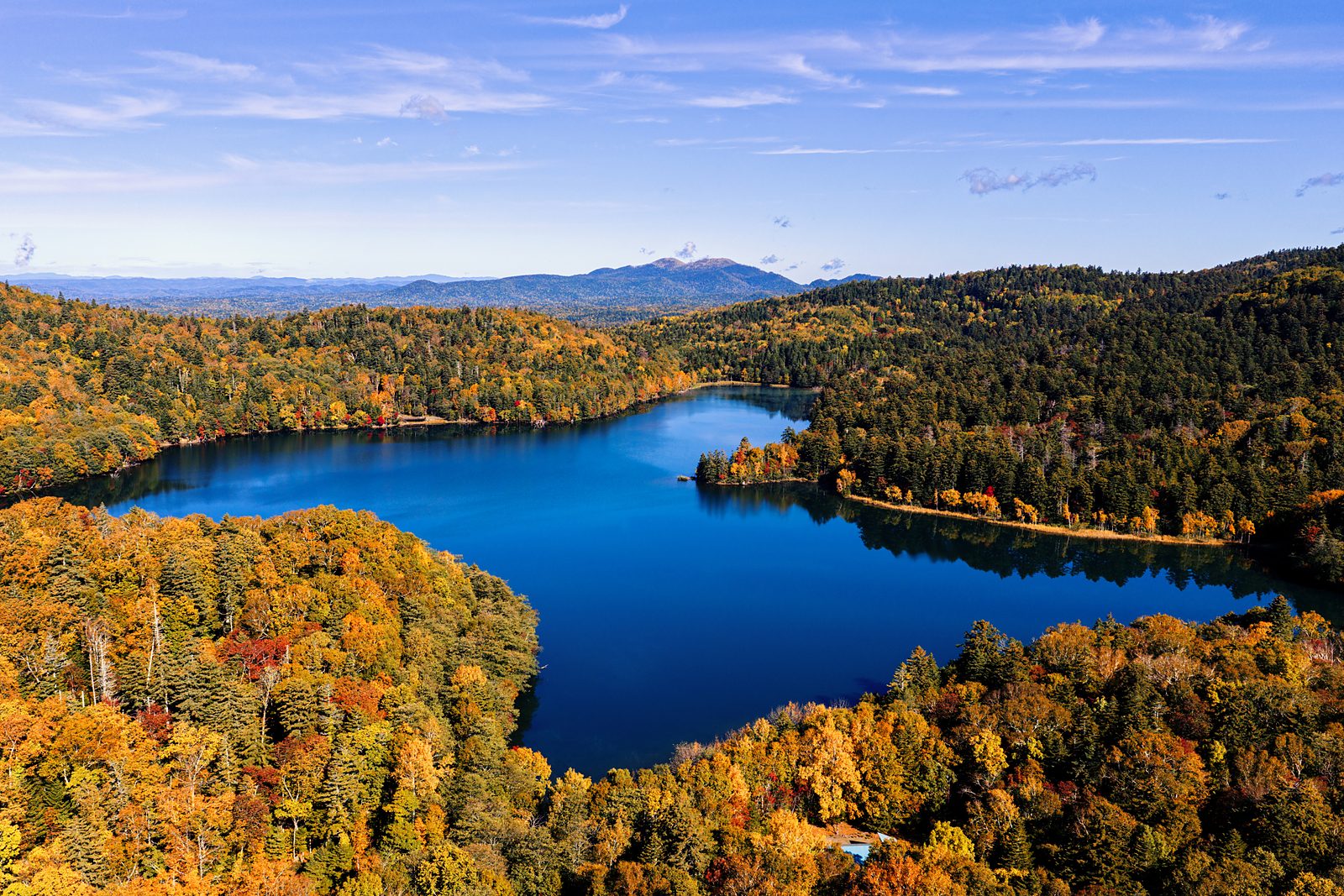
Autumn starts in Hokkaido earlier than anywhere else in Japan, with the season's colours beginning near the summits from late August, peaking at altitude around the middle of September, and working down to the onsen villages and the lowlands through October. It gives some absolutely beautiful views, with the forests turning a deep mix of red, orange and gold, making it a great time to visit Hokkaido.
Temperatures cool quickly as the days go by. While October days are crisp and pleasant, generally sitting in the low to mid teens, by November the cold settles in and you'll start seeing the first snow. So unless you love chilly weather, bringing some warm clothes would be for the best, keeping you warm enough for those cool mornings and evenings while still having the flexibility to adjust as the afternoon warms up. Also, a raincoat or umbrella is worth packing as autumn rain is fairly common across the island.
Crowds are noticeably heavier than in spring, particularly at places renowned for their scenery, so accommodation in popular areas books out fast. If your timing is flexible, coming just before or just after peak colour gives you much of the beauty with considerably fewer people around.
Where to go in autumn
Here's where autumn in Hokkaido is at its best.
Daisetsuzan
Where Hokkaido's colour begins, from late August in the highlands.
We've established that autumn starts in Hokkaido before anywhere else, but the starting point specifically is in Daisetsuzan which is Japan's largest national park. At Daisetsuzan you'll see the leaves begin to turn as early as late August at the higher elevations, and if you were to stay and watch long enough, you'd see how the colour change makes its way down from the peaks through September.
A great way to see this is by going up with the Asahidake ropeway that carries visitors up to around 1,600 metres, where red, orange and gold stretch out in every direction from the top station. On clear days the Sugatami Pond near the upper station reflects Asahidake and the combination of the volcanic peak, the still water, and the surrounding colour is one of the finer views in Hokkaido at any time of year. For those who want to move through it rather than look at it from the viewing deck, hiking trails from the upper station head out across the mountaintop.
Sounkyo Gorge
Sheer basalt walls packed with forest that turns through October.
Sounkyo Gorge is another place where you can enjoy seeing autumn foliage in Hokkaido, where the steep rock walls and the sweeping forest that fills the gorge make the colour here stand out more than almost anywhere else in Hokkaido. The leaves usually peak through early to mid October, and the road that runs through the gorge with the foliage on both sides makes it a great reason to rent a car and drive through. Along the way you'll pass the Ryusei and Ginga waterfalls, a pair of waterfalls cascading down the rock walls. For a wider view, the ropeway and chairlift up from the hot spring town at the base of the gorge carry you up to the top of the gorge, where on clear days the autumn foliage across the national park stretches all the way to the horizon.
Onuma Quasi-National Park
Lake reflections of maple and Mount Komagatake through October.
Onuma Quasi-National Park is worth visiting at any time of year but you could definitely argue that autumn is the best time to visit. To start off with, the lakeside trees change colour through October, and with Onuma's calm water and those coloured trees along the shore, it's one of the prettier lake scenes in Hokkaido, and behind the lake sits Mount Komagatake, giving the whole scene a striking backdrop. You can get amongst it all on the cycling paths and walking trails through the park, or take a rowing boat out onto the lake itself. Overall, coming here would definitely make for a nice, slow and relaxed day.
Noboribetsu Onsen
Steam from Jigokudani rising against the autumn hillsides.
Noboribetsu is Hokkaido's most famous onsen town, drawing visitors for its hot springs and volcanic scenery. The volcanic valley of Jigokudani, which literally translates to Hell Valley, supplies the town its hot spring water and is surrounded by forest that turns vivid red and yellow through October. What makes it special is the sight of white steam rising from the steam vents against the red and gold of the surrounding hills, something you won't find at any other hot spring in Japan. On top of that, the walking path through Jigokudani is lit up at night, and the low lighting gives it a different feel to the daytime. But we can't forget that just soaking in a hot spring surrounded by nature in the cool air is an experience everyone should try.
Shiretoko Peninsula
Brown bears feeding on salmon, and colour over a World Heritage coast.
Shiretoko is worth visiting in autumn for two reasons in particular. The first is the brown bears, which through September and October are in the most active feeding period before hibernation and can be found moving along the rivers and coastal areas of the peninsula following the salmon that are running upstream at the same time. The bear watching boat tours that cruise the coastline have their best sighting rates of the year through these months, and watching wild bears feed on salmon in a landscape that is a UNESCO World Heritage Site is about as wild as it gets. The second is the foliage. Shiretoko's volcanic peaks, coastal cliffs and ancient forest give the colour a punch that a lot of other foliage spots just don't have. The best place to take it in is the 知床五湖 (Shiretoko Goko) elevated boardwalk through the five lakes, at its best in October when the autumn colour reflects in the still water below, and one of the better short walks in Hokkaido at any time of year. The best part is that because it is raised and bear proofed, it is free and you can walk it any time without a guide, which is not the case for the ground trails through the same area.
Seasonal experiences and events
Pick the prefecture on the map to see what is on this autumn.
Prefecture map
Seasonal food & atmosphere
Autumn is Hokkaido's richest table. Open a card for the detail and a few images.
Salmon and ikura
The autumn run reaches Hokkaido first, and the roe is at its plumpest.
Salmon is the fish autumn is built around in Hokkaido. From September the 秋味 (akiaji), the autumn flavour run, returns from the ocean to spawn in the rivers it was born in, and across the island you can watch the fish working their way upstream in enormous numbers. The catch from this run is fatty and rich, so it holds up grilled, simmered, smoked or dropped into a hot pot. Two preparations belong to Hokkaido rather than anywhere else. ちゃんちゃん焼き (Chanchan Yaki) is a whole split fish laid on a hot plate under miso and butter with cabbage and onion piled around it, a fishermen's dish from the Ishikari coast. ルイベ (Ruibe) is salmon frozen hard and sliced thin so it is eaten half thawed, a method that came from Ainu preservation practice. Alongside the fish comes イクラ (Ikura), the roe, which in autumn is plump, glistening and cleanly briny in a way the out of season product never is, eaten as イクラ丼 (Ikura Don) in generous spoonfuls over rice.
Mushrooms
Rakuyou, maitake, and more from the island's forests.
Hokkaido's forests are full of mushrooms. Maitake, nameko, and matsutake all have their season through autumn, and they find their way into everything from simple grilled dishes to hot pots and rice, adding an earthy, savoury flavour. But the one to know about here is ラクヨウ (rakuyou), the mushroom Hokkaido locals actually head into the forest for. It grows only on the floor of the island's larch forests, living off the roots of the trees, which is why it has never been farmed, and it is only around fresh for about a month from September into October. Slippery like nameko with a rich, earthy taste, it goes best in miso soup and hot pots, and if you spot it on a menu or at a market, don't pass it up. Matsutake gets the headlines elsewhere in Japan, but rakuyou is the local favourite, and eating it here is the local experience.
Pacific saury
The first of the season, landed at Nemuro and Kushiro, grilled whole with sudachi and grated daikon.
Pacific saury reaches Hokkaido before it reaches anywhere else. The fish run south along the Pacific coast from late August and the boats out of 根室 (Nemuro) and 釧路 (Kushiro) land the first of the season, which is why the price on a mainland fishmonger's board falls the week the Hokkaido catch starts. The preparation has barely changed and does not need to. It is grilled whole over heat until the skin splits, with a squeeze of sudachi and a mound of grated daikon on the side to cut the oil. The fish is rich and soft boned enough that people eat it from head to tail, and eating it on the island in September, a day or two off the boat, is as close to the source as it gets.
Japanese pumpkin
A dense, sweet autumn crop the island grows in quantity.
Pumpkin, known in Japan as カボチャ (Kabocha), is one of Hokkaido's major crops, and the island grows around half of Japan's supply. Harvested in late summer, the pumpkins are left to cure for a couple of months, concentrating the sweetness, which is why autumn is when kabocha is at its best. Dense, sweet and full of flavour, it finds its way into everything from tempura and simmered dishes to soups and desserts through the season.
New season rice
Freshly harvested rice, at its best steamed and plain.
Rice is harvested across Japan in autumn, and the arrival of the new season's crop, 新米 (shinmai), is a big deal in a country that takes its rice seriously. Freshly harvested rice has a moisture and fragrance that rice that was harvested and stored earlier does not, and eating it simply, steamed and served plain, is one of those experiences that shows you why rice matters so much in Japan. Hokkaido has developed into a serious rice producing region over recent decades and its autumn shinmai, particularly the Nanatsuboshi and Yumepirika varieties that the island has become known for, is worth going out of your way for if you are there at the right time of year.
Grapes
The harvest behind Hokkaido's small but growing wine.
This may come as a surprise to some, but Hokkaido has quietly become Japan's third largest wine region, and it is still growing. The island's cool climate suits grape varieties that struggle in the warmer regions further south, mostly German ones like Kerner and Zweigelt, and the harvest runs through autumn, with fresh grapes appearing at roadside stalls and in stores along the way. The wines tend to be light and aromatic, which is exactly what the climate gives, and if Japanese wine is something you have any interest in, visiting during the harvest and tasting what is actually being produced is a far better introduction than reading about it.
Shishamo smelt
A local smelt, best as the roe carrying autumn females.
Shishamo smelt is a small fish found nowhere in the world except Hokkaido, and one of the most distinctly local things you can eat on the island. The females caught in October and November, when they are carrying roe, are the ones to try. Grilled whole and eaten from head to tail, they have a richness and depth the shishamo served at izakayas does not come close to, because the shishamo most people encounter across Japan is almost always capelin, an imported lookalike from the north Atlantic rather than the real thing. The real ones are caught along Hokkaido's Pacific coast for only a month or so each autumn, and the town of Mukawa is the heart of it all.