
What autumn feels like
Autumn is widely considered Tohoku's most beautiful season, and it's easy to see why. The region's forests, volcanic highlands and mountain valleys turn deep shades of red, orange and gold from late September onwards. It starts high up in the mountains and moves down through October and into November, and the lowlands stay colourful into late November. With a region this large and varied, there's always somewhere new to see it.
Temperatures drop steadily as the season goes on. September still carries some of summer's warmth, especially in the south of the region, but by October the days are crisp and cool across most of Tohoku, generally sitting in the low to mid teens. November turns cold quickly, especially in the north and up in the mountains, so pack some warm clothes, and it's worth packing a raincoat or umbrella too.
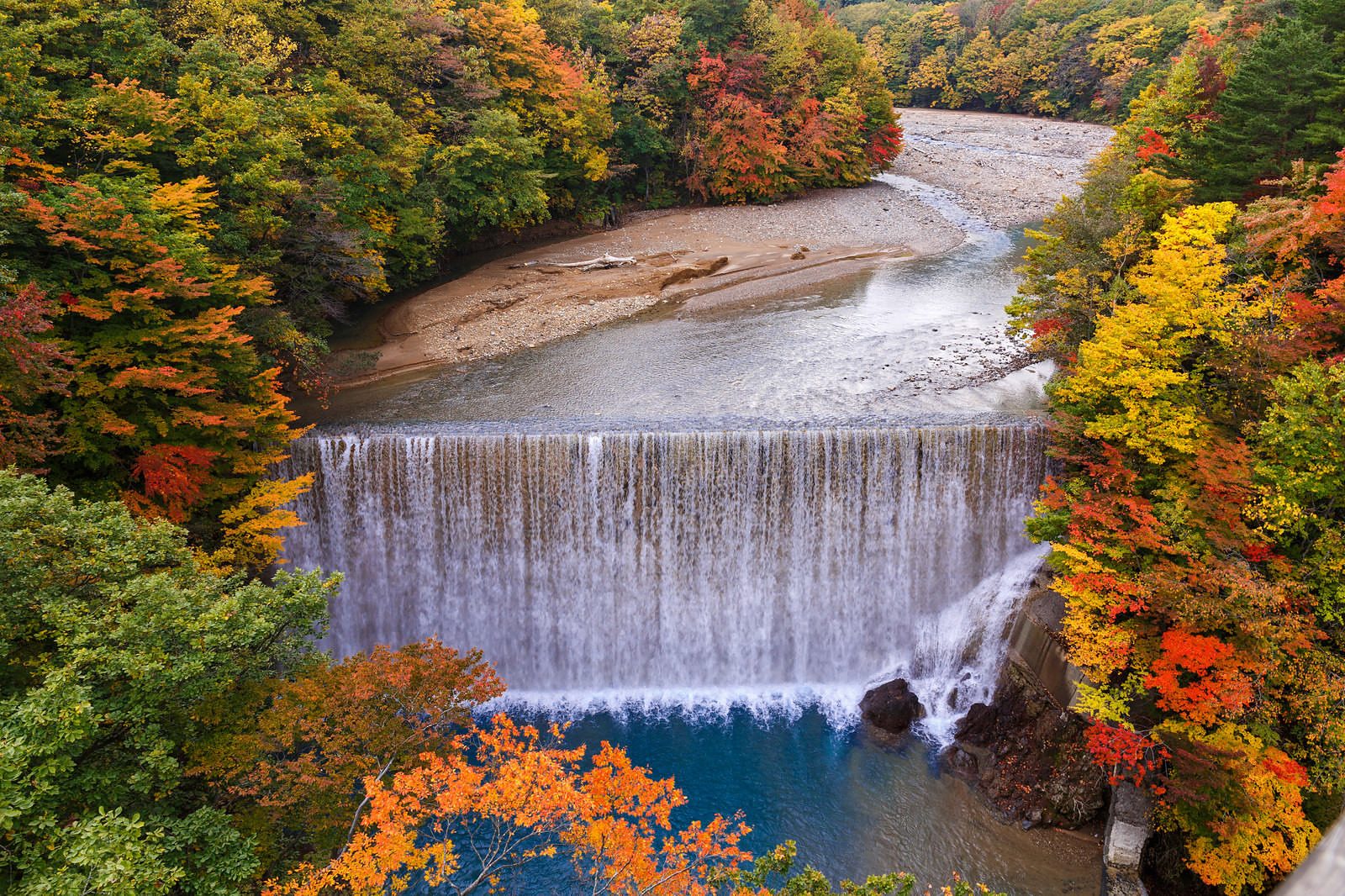
Crowds pick up around the famous foliage spots when the foliage is at its peak, especially on weekends, and accommodation in the popular areas books out fast. If your timing is flexible, aim for the week just before or after the peak. You'll get most of the foliage with far fewer people around.
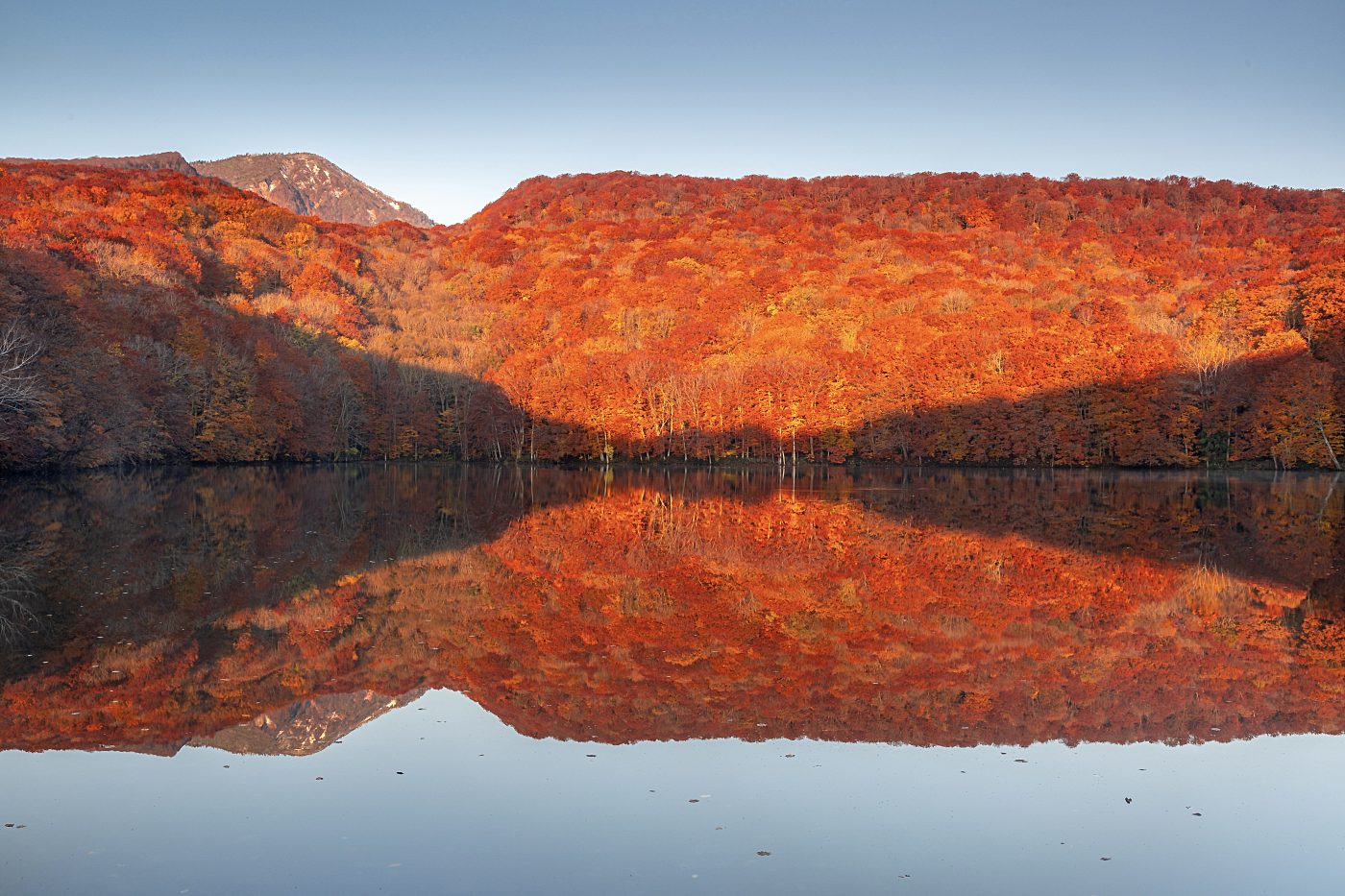
Despite the cooling weather, autumn is one of the best times to get out into Tohoku's more remote corners. The air is clear, and the foliage against the region's mountains and gorges makes for some spectacular scenery.
Where to go in autumn
Autumn in Tohoku is one of the best times and places for autumn foliage in Japan, and between the mountain ranges, river gorges and caldera lakes, no two spots look the same. The season moves through the region from the high mountains down to the lowlands through September, October and into November, which means that travelling through Tohoku and following the leaves as they turn down the mountains is one of the best ways to experience autumn in Japan.
Oirase Gorge (奥入瀬渓流)
A fourteen kilometre forested river gorge of waterfalls and moss, with colour peaking from late October into early November.
Over a dozen waterfalls cascade down the walls of Oirase Gorge (奥入瀬渓流), a 14 kilometre forested river gorge in Towada City in Aomori Prefecture spanning from Nenokuchi on the shore of Lake Towada down to Yakeyama. The walking trail follows the river along its full length on a flat paved path through thick moss carpeting the rocks and forest floor, with the beech, maple, oak and birch overhead turning red, orange and gold from late October into early November in the peak of autumn. The gorge is designated both a National Special Place of Scenic Beauty and a National Natural Monument, holds two stars in the Michelin Green Guide, and sits inside Towada-Hachimantai National Park. The JR Bus Tohoku goes to the gorge entrance at Yakeyama from JR Aomori Station in around 2 hours (¥2,650) and from JR Hachinohe Station in around 1 hour 30 minutes, with the buses running from roughly mid April to mid November only. It's worth knowing that in recent years private cars have been banned from the gorge road during the late October foliage peak, with a paid shuttle bus running instead, so check the current arrangements before planning to drive. Bicycle rentals at Yakeyama (¥1,000 for 4 hours, ¥1,500 with electric assist) let you ride the trail one way and drop the bike at Nenokuchi for those wanting to cover more ground than a single afternoon walk allows.
Lake Towada (十和田湖)
A deep volcanic caldera lake straddling two prefectures, with colour on the caldera walls from mid to late October.
Pleasure boat cruises across Lake Towada (十和田湖) take about 50 minutes between Yasumiya at the southern shore and Nenokuchi at the eastern shore, from ¥1,760 for adults, with deck space for open viewing of the forested caldera walls that change colour from mid to late October each year. The lake sits across the Aomori and Akita prefectural border in a volcanic caldera formed by repeated massive eruptions, the biggest of them around 15,000 years ago, and reaches 327 metres deep as Japan's third deepest lake. It is actually a double caldera, with the deepest section formed by a second eruption inside the first caldera around 6,000 years ago. The lake even created the Oirase Gorge. When the rim gave way around 15,000 years ago, the escaping flood carved out the valley the gorge runs through today. The colour on the caldera walls peaks a little earlier than down in the gorge, so if you're doing both in a day, start with the lake and finish in the gorge. The JR Bus Tohoku goes to the lake at Yasumiya from Aomori Station in around 3 hours for ¥3,480 and from Hachinohe Station in around 2 hours 15 minutes, with the buses running from roughly mid April to mid November only.
Naruko Gorge (鳴子峡)
A 100 metre deep gorge above Naruko Onsen, peaking from late October into early November.
Naruko Onsen is a small hot spring town in northwestern Miyagi Prefecture known for Naruko Kokeshi wooden dolls (which squeak when the head is turned, with painted chrysanthemum patterns down the body) and for Naruko Gorge (鳴子峡), which sits in the surrounding hills, about 10 to 15 minutes from the town centre by taxi. The gorge was carved 100 metres deep by the Oya River, and its walls are covered in beech, oak, maple and mountain cherry. When they peak from late October into early November, the reds, yellows and oranges stand out against the white rock faces the gorge is known for. The arch of Ofukazawa Bridge spans the gorge and is best seen from the observation deck by the Naruko-kyo Rest House, which is also the start of a 2.2 kilometre walking trail that loops through the wooded slopes in about 50 minutes. The JR Rikuu East Line between Naruko Onsen Station and Shinjo has been suspended since heavy rain damage in July 2024, with replacement buses covering that section and no reopening date announced, though trains from the Sendai side still reach Naruko Onsen Station as normal. A temporary "Momiji-go" autumn shuttle bus runs from Naruko Onsen Station to the gorge during the foliage season for a few hundred yen one way.
Zao Okama Crater Lake (蔵王の御釜)
A colour changing crater lake on the Zao range, with alpine foliage peaking from late September into late October.
Zao Onsen on the Yamagata side of the Zao mountain range has 1,900 years of recorded bathing history and three public bathhouses fed by strongly acidic sulphur water, all of which sit at the foot of the same volcano that holds the Okama (御釜) crater lake up at its summit. The crater stretches 325 metres across and is 27.6 metres deep, with strongly acidic water that shifts between emerald green, turquoise and blue depending on sunlight and mineral concentration. The lake is locally called Goshiki-numa (Five Colour Pond) for this changing colour. Autumn foliage on the alpine slopes surrounding the crater peaks from late September into late October, earlier than the lowland foliage spots in Tohoku. From Zao Onsen, you can get to the lake either by hiking 45 minutes from the upper station of the Zao Ropeway to the main summit, or driving the Zao Echo Line and the connecting Zao High Line toll road (¥600 for standard cars) to Kattadake parking and walking 10 minutes to the observation deck. Both mountain roads close from early November to late April for snow, and overnight closures apply in parts of the season, including from mid October, so check the road information if you're planning an early start.
Kakunodate Samurai Street (角館武家屋敷通り)
A preserved Edo samurai district under maples and weeping cherries, with colour from late October into early November.
Around 400 weeping cherry trees (shidarezakura) grow across the town of Kakunodate (角館) in Semboku City in central Akita. The story goes that they began as seedlings a samurai bride brought from Kyoto in the 17th century, and 162 of the trees are designated Natural Monuments of Japan, some over 300 years old. The town is about a 3 hour ride from Tokyo on the Akita Shinkansen and was founded in 1620 by Yoshikatsu Ashina. The old town is split in two, the Uchimachi samurai district to the north and the Tomachi merchant district to the south, with an old firebreak strip between them. The samurai district holds a row of former bukeyashiki residences with six currently open to the public, including the oldest surviving Ishiguro House, which the family still lives in today, and the large Aoyagi family estate with museums and gardens. In autumn the weeping cherry leaves turn yellow alongside the maples that turn red and gold, peaking from late October to early November, and the samurai district is lit up in the evenings through the foliage season. Kakunodate Station is a 15 to 20 minute walk south of the samurai district.
Chusonji Temple (中尊寺)
A World Heritage temple and its gold Konjikido hall under maples and ginkgo, peaking from late October into early November.
The Tsukimizaka approach to Chūson-ji (中尊寺) in Hiraizumi in southern Iwate Prefecture runs uphill for a few hundred metres through a corridor of ancient cedars hundreds of years old, and from late October into early November the maples and ginkgos beneath the cedars turn red and gold against the dark trunks. The climb up the slope leads to the Konjikidō Golden Hall, the 1124 gold leaf memorial built by the Ōshū Fujiwara clan and the only original 12th century structure surviving at the temple, with autumn colour all around the white enclosure that protects it. The "Momiji Ginga" autumn illumination runs in the evenings across the late October to early November colour (in 2025 it was held from 25 October to 9 November, 4:30pm to 6:30pm, but check the official Chūson-ji site for current dates). From here you can pair the morning at Chūson-ji with an afternoon at Mōtsū-ji, a short walk away, where autumn maples reflect in the central pond of its Pure Land garden. JR Hiraizumi Station is around 10 minutes from Ichinoseki on the Tohoku Main Line, with the Hiraizumi Loop Bus reaching Chūson-ji in 10 minutes.
Seasonal experiences and events
Prefecture map
Seasonal food & atmosphere
Autumn is probably the best season to eat in Tohoku. The region's rivers, coastline, forests, and farmland all deliver their best at roughly the same time, and the overlap of so many exceptional seasonal ingredients makes it an exciting time to visit if you're travelling for the food.
Salmon
The autumn run fills the Sanriku rivers, and Miyagi cooks the rice in the broth.
Salmon is the autumn fish in Tohoku as it is in Hokkaido, but the region's own dish is what to look for. From September the rivers fill with fish returning to spawn and the catch is full and rich, turning up grilled, simmered and in hot pots through the season. What Tohoku does with it is はらこ飯 (Harako Meshi), a Miyagi dish from the 亘理 (Watari) area at the mouth of the Abukuma River. The rice is cooked in the broth the salmon was simmered in, so it takes the colour and the flavour, then flaked salmon goes on top and the roe goes over that. The roe here is called はらこ (harako) rather than ikura, which is where the name comes from. It is a rice dish rather than a sashimi bowl, and it belongs to about six weeks of the year.
Pacific saury
Landed at Kesennuma fresh enough to eat raw, which is rare for this fish.
Pacific saury is one of the most strongly seasonal fish in Japanese cooking, and Tohoku's claim on it is 気仙沼 (Kesennuma) in Miyagi, a port that has handled more fresh sanma than anywhere else in the country. Being landed fresh rather than frozen matters, because it makes 生さんま (raw sanma) possible, sliced as sashimi or laid over vinegared rice, which is not something the fish survives well once it has travelled. By the time the run reaches the Sanriku coast it is at its oiliest, so the standard treatment, grilled whole with grated daikon and a squeeze of citrus, is excellent here too. But the raw version is the reason to eat it in Tohoku specifically rather than further north.
Matsutake mushrooms
Iwate's pine forests, and a mushroom picked wild because nobody has managed to farm it.
Matsutake cannot be cultivated. It grows only in a living relationship with red pine roots, which is why every one on sale was picked by hand out of a forest, and why the price is what it is. Iwate is one of the country's main sources alongside Nagano, and the fruiting runs through September and October as the mountains cool, on a schedule nobody can predict from one year to the next. Tohoku's treatment is the plainest of the three matsutake regions, with 松茸ご飯 (Matsutake Gohan), rice cooked with the mushroom sliced through it so the fragrance runs into every grain, and 土瓶蒸し (dobin mushi), a clear broth steamed in a small clay pot and drunk from the lid. The aroma is the point, so nothing is added that would compete with it.
Apples
Aomori leads Japan's apple harvest, picked fresh through autumn.
Apples are harvested across Tohoku through autumn, and Aomori is the centre of Japanese apple growing, responsible for more than half the country's total output. The varieties grown here, Fuji, Tsugaru and Orin among them, are large, crisp and intensely sweet, and the autumn harvest brings them to roadside stalls, farm shops and markets across the prefecture in abundance.
Persimmon
Sweet, honeyed fruit ripening across the region's gardens and hillsides.
Persimmon appears across Tohoku in autumn, ripening on trees in the gardens and hillsides of the region. The flesh is sweet and slightly honeyed when fully ripe, and it is eaten fresh, dried into a concentrated chewy snack known as 干し柿 (Hoshi Gaki), or used in autumn sweets. In fact, Tohoku is the home of a dried version sold right across the country, Fukushima's soft, jelly textured anpo-gaki, and in late autumn you see rows of them hung up to dry.