
General feeling of the region
Kyushu greets spring earlier than most of Japan. The island's southerly position and generally warmer baseline climate mean that cherry blossoms arrive in some areas as early as late March, and by the time the rest of the country is hitting peak blossom season Kyushu is already moving into the fuller, greener days of mid spring. That head start gives the island a particular appeal for travellers who want to chase the season or who are visiting Japan in the earlier part of spring when conditions further north are still cold and unsettled.
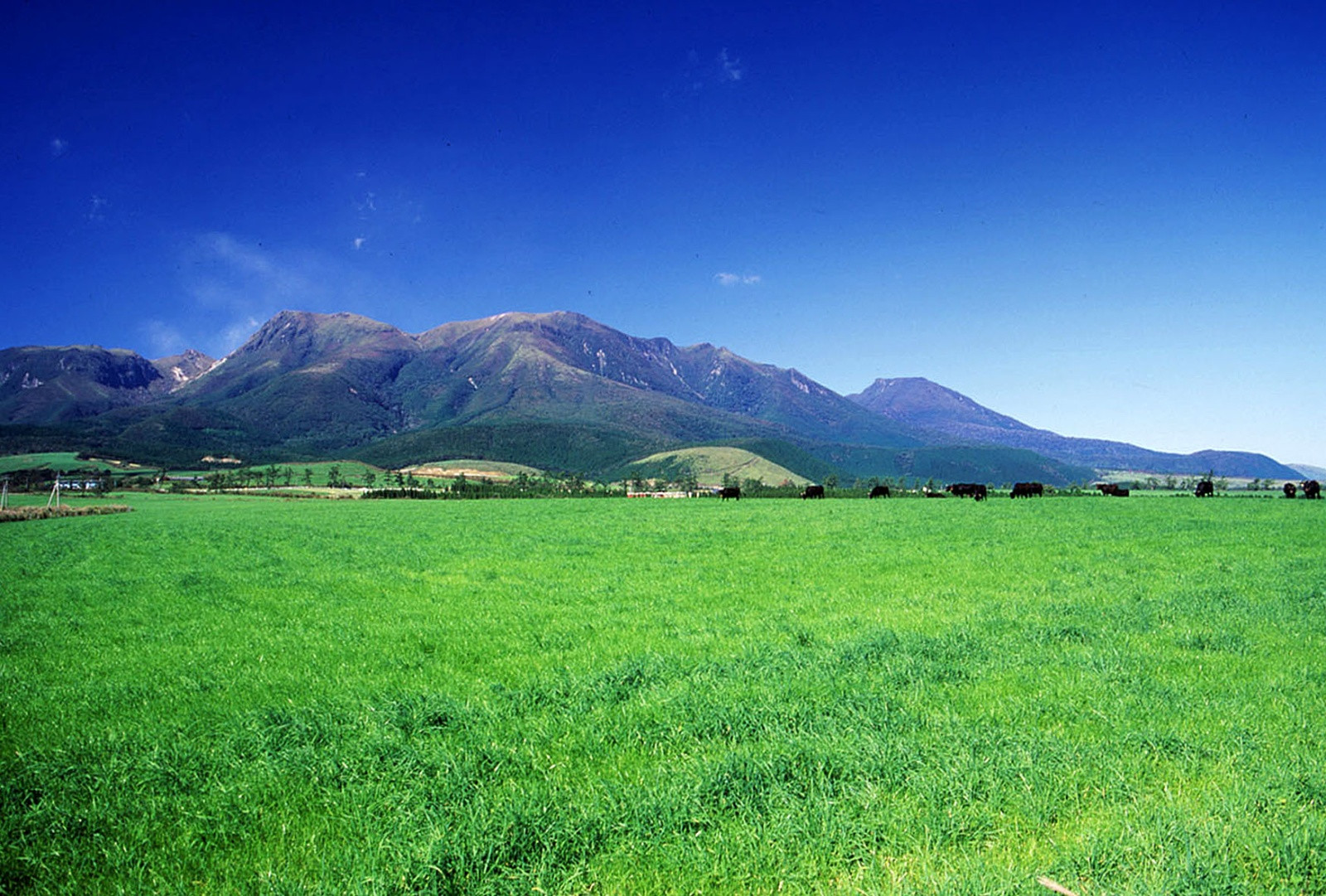
The island's geography is varied enough that spring plays out differently depending on where you are. The northern prefectures of Fukuoka and Saga are broadly mild and accessible from early spring, and Fukuoka in particular functions as a confident, well connected city that handles the season with a relaxed energy that feels distinct from the more tourist heavy spring atmosphere of Kyoto or Tokyo. Moving south through Kumamoto and into Kagoshima the landscape opens up into volcanic terrain, wide river plains, and eventually the subtropical character of the far south where the concept of a conventional spring season becomes somewhat loose. It is warm here for much of the year and the transition from winter is correspondingly gentle. The mountainous interior of Oita and the rural areas of Miyazaki sit between these two poles, with forested highlands that hold spring colour longer than the coastal lowlands and offer a quieter, more rural experience of the season.
Temperatures across Kyushu in spring are generally warmer than the national average for the time of year. April sits comfortably in the mid to high teens across most of the island, warming into the low twenties by May, and the far south around Kagoshima and the Amami islands runs warmer still. Light layers cover most situations through April with lighter clothing appropriate by May across the lowland areas. Rain is worth factoring in. Kyushu sits in a part of Japan that receives significant rainfall and spring showers are common, particularly in the western prefectures. A compact waterproof layer is a practical addition to any spring packing list for the island.
Getting around Kyushu is well supported by both rail and road. The Shinkansen runs down the western side of the island connecting Fukuoka, Kumamoto, and Kagoshima efficiently, and the major cities are linked by a network of express trains that make moving between them easy. The rural interior, the volcanic areas around Aso, and the more remote parts of Miyazaki and the southern coast are best accessed by rental car, and spring is a good season to drive the island. The roads are clear, the scenery is vivid, and the relatively low international tourist numbers outside of the major cities mean that even popular natural areas feel spacious and unhurried.
Okinawa in Spring
Okinawa in spring feels like a different country from the rest of Japan, and in many respects it is. The subtropical climate that defines the archipelago means that the seasonal shifts which shape travel across Honshu, Shikoku, and Kyushu are far less pronounced here. Spring arrives not as a dramatic transition from winter but as a gentle continuation of the warmth that Okinawa carries through most of the year. The main island and the outer island groups to the southwest are already green, already warm, and already fully alive well before the cherry blossoms have opened anywhere else in Japan. In fact Okinawa has its own cherry blossom season that runs in January and February, earlier than anywhere else in the country, meaning that by the time the rest of Japan is celebrating spring, Okinawa has already moved past it.
Temperatures on the main island through spring sit comfortably in the low to mid twenties through March and April, warming into the high twenties by May as the season begins to transition toward the rainy season that typically arrives in Okinawa in mid May, earlier than anywhere else in Japan. That early rainy season is worth factoring into travel planning, particularly for visitors arriving in late May who may encounter persistent rain and overcast conditions that affect beach and outdoor activities. March and April represent the sweet spot for spring travel to the main island, warm enough for the water and outdoor exploration, settled enough to avoid the rain, and outside of the peak summer crowds that take over from late June onwards.
The outer islands tell a slightly different story and are worth understanding separately. The Kerama Islands sitting just west of the main island share much of the same spring climate but carry a quieter, less developed character that makes them appealing for travellers who want clear water and natural scenery without the infrastructure of the main island. The Yaeyama Islands, Ishigaki, Iriomote, and the smaller islands around them, sit further southwest and run even warmer, with a climate and landscape that edges toward the tropical. Spring is one of the better times to visit the Yaeyamas before the rainy season arrives and before the intense summer heat and humidity sets in, and the combination of coral reef, jungle interior, and almost empty beaches in March and April is difficult to match anywhere else in Japan.
Packing for Okinawa in spring is lighter than anywhere else covered on this page. T-shirts and light clothing cover most days comfortably, with a light layer useful for evenings and air conditioned spaces which run cold across the islands regardless of the outdoor temperature. A good rain layer is worth having given the unpredictability of spring weather, and reef safe sun protection is worth prioritising for anyone spending time in or around the water. The UV intensity in Okinawa is meaningfully higher than on the mainland and catches visitors off guard more often than it should. Getting around the main island is easy by rental car, which is the practical choice outside of Naha. The outer islands require ferry or short domestic flights to reach, and accommodation on the smaller islands books up faster than you might expect given their limited capacity, making advance planning more important than the relaxed atmosphere of the islands themselves might suggest.
Exploring Kyushu
Spring in Kyushu arrives earlier than anywhere else in Japan and the combination of the island's warm climate, its volcanic highland landscapes, and the historic castles, shrines, and canal towns that define its cultural identity gives the season a range and energy that rewards exploring across all seven prefectures. The spots below cover the full geographic breadth of the island from the historic shrine town of Fukuoka in the north to the volcanic landscapes of Kagoshima in the far south.
Dazaifu Tenmangu Shrine (太宰府天満宮)
The principal Tenmangu shrine, dedicated to the deity of learning, with around 6,000 plum trees that bloom from late February.
The Tobiume or "flying plum tree" standing to the right of the main hall of Dazaifu Tenmangu (太宰府天満宮) in Dazaifu City in Fukuoka Prefecture is the most historically charged single plant in any shrine in Japan, said in legend to have flown overnight from Kyoto to Dazaifu to be with the exiled scholar Sugawara no Michizane after his 901 banishment, and it is traditionally the first plum tree in the country to bloom each year. Around 6,000 plum trees of around 200 varieties fill the rest of the shrine grounds and bloom from late January to early March, drawn from the Tenjin scholar god's lifelong devotion to plum blossoms reflected in the shrine's plum blossom emblem. Dazaifu Tenmangu is the head shrine of the around 12,000 Tenmangu shrines across Japan and is built on Michizane's grave site, with the current Momoyama style main hall dating to 1591 and currently under its first major renovation in 124 years, with a temporary main hall designed by Sou Fujimoto with real trees growing on its roof standing in front of it through to around 2026. The 400 metre Sando approach from Dazaifu Station is lined with shops selling umegae mochi, the local plum branch rice cake. From Nishitetsu-Fukuoka Tenjin Station the Nishitetsu Line runs to Dazaifu Station in around 25 minutes with a transfer at Futsukaichi, with a 5 minute walk from the station to the shrine entrance.
Yanagawa Canal Town (柳川)
A canal town crossed by flat bottomed boats poled along the old waterways, with cherry blossom along the banks in spring.
A 4 kilometre kawakudari boat ride along the canals of Yanagawa (柳川) in southern Fukuoka Prefecture takes around 60 to 70 minutes in a flat bottomed wooden donko-bune navigated by a boatman with a single long pole, with the boatman singing local folk songs as the boat winds through the canals beneath cherry trees in bloom along parts of the route in late March and early April, and the surrounding willows reaching down to the water. Yanagawa is a historic castle town that the Tachibana clan ruled from 1620 to 1871, with the network of around 470 kilometres of canals originally built for irrigation, flood control and fire prevention and now the defining feature of the town. The standard adult boat fare is around ¥1,500 to ¥1,700 one way, with several operators running from docks within a 5 minute walk of Nishitetsu-Yanagawa Station. The Yanagawa Hina Matsuri Sagemon Meguri runs from mid February to April 3 with colourful hanging hina doll decorations displayed throughout the town and an Ohina-sama Water Parade in mid March down the canals. Ohana, the former Tachibana residence at the end of the standard boat route, houses the Shoto-en garden modelled after Matsushima Bay alongside the white Seiyokan Western style hall and a samurai era museum. From Nishitetsu Fukuoka Tenjin Station the Nishitetsu Tenjin-Omuta Limited Express runs to Nishitetsu-Yanagawa Station in around 45 minutes at ¥870.
Kumamoto Castle (熊本城)
One of Japan's three great castles, known for its curving warrior repelling walls, with cherry trees through the grounds and ongoing earthquake restoration.
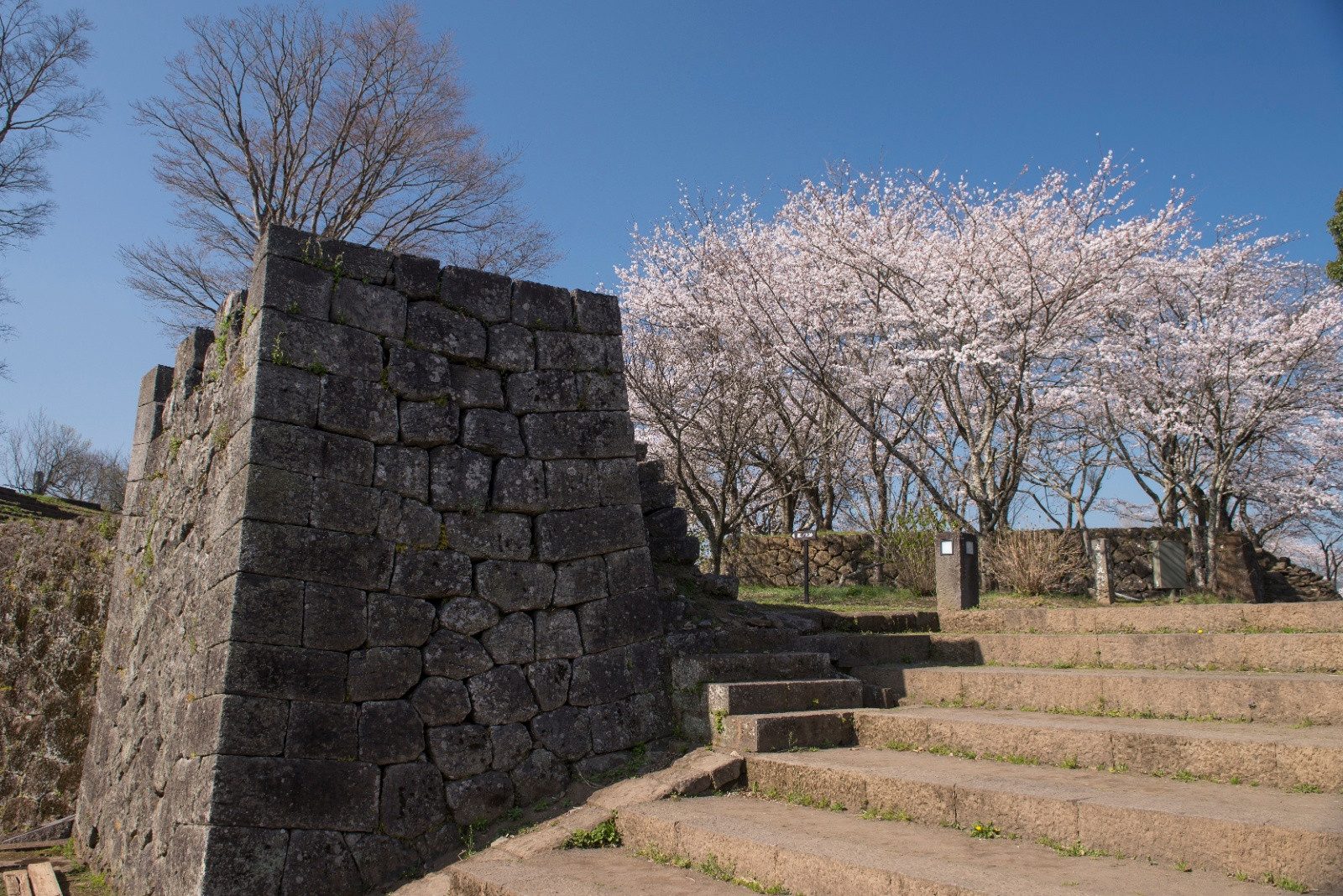
Kumamoto Castle (熊本城) is one of Japan's three premier castles alongside Himeji in Hyogo and Matsumoto in Nagano, completed in 1607 by the warlord Kato Kiyomasa, renowned as a castle architect, who had begun work at Chausuyama around 1599. Its distinctive 武者返し (musha-gaeshi) or "warrior repelling" stone walls curve outward from their base at a gentle angle before turning nearly vertical at the top, which makes them close to impossible to scale, and the castle in Kumamoto City has become the symbol of Kyushu's recovery from the 2016 Kumamoto earthquakes. Kumamoto City's recovery plan records damage across 517 faces of stone wall, around 29.9 per cent of the total wall area, with 50 separate collapse sites, along with damage to all 13 of the castle's Important Cultural Property buildings and 20 reconstructed structures. The main keep was restored and reopened in 2021, but full restoration of the wider complex is projected to continue until 2052, with a 350 metre elevated Reconstruction Viewing Corridor opened in 2020 that takes visitors above the damaged stone walls at eye level with the active restoration work below. Cherry trees of around eleven varieties fill the castle grounds and bloom in late March and early April, with the Miyukizaka slope on the south side and the cherry tree tunnel along the path from Ninomaru Plaza on the west side to Nishi-otemon Gate the standout viewing spots. The annual Kumamoto Castle Spring Festival runs through the bloom period with Japanese taiko drumming, samurai costume performances, food stalls and special tours observing the restoration progress. The blossom lighting is a short run in the second half of March and the opening days of April rather than a month long season. The castle's spring evening opening held the paid area open until 20:00 from 22 March to 6 April in 2025, closed the Miyukizaka carriageway to traffic for pedestrians from 17:30 to 21:00, and lit the cherry trees there and along the Nishi-otemon approach between Ninomaru Plaza and Kato Shrine, which stayed open to 21:00. A separately sponsored cherry illumination ran along the Nagabei-mae cherry avenue from 18:00 to 22:00 on the ten evenings from 20 to 29 March 2026 and was free to walk. Castle admission is ¥800. A magnitude 7.1 earthquake with a maximum seismic intensity of 7 struck Kumamoto on 28 July 2026, and the castle reopened on 13 August 2026 with the paid area running normally, although the Wakuwaku-za museum was still closed and several castle events had been cancelled as of 18 August 2026, so check the castle's official site before fixing a 2027 spring date. From Hakata Station the Kyushu Shinkansen runs to Kumamoto Station in around 32 minutes at fastest, with the city tram from there to the Kumamoto-jo Mae stop. Going on a weekday evening avoids the weekend crowds while the castle and the blossom are both lit.
Nagasaki Glover Garden (長崎 グラバー園)
Historic Western merchant residences on a hillside above Nagasaki Harbour, including Japan's oldest surviving Western style wooden building.
Glover Garden (グラバー園) on the Minamiyamate hillside above Nagasaki Harbour is an open air museum of preserved Western style residences from the early Meiji period, with the Former Glover Residence built in 1863 the oldest surviving Western style wooden building in Japan and registered in 2015 as part of the UNESCO World Heritage "Sites of Japan's Meiji Industrial Revolution". The Scottish merchant Thomas Blake Glover arrived in Nagasaki in 1859 at the age of 21 and went on to help establish Japan's first modern coal mine, the country's first modern shipyard, and the company that became Mitsubishi Corporation, with his house also inspiring the setting of Puccini's opera "Madame Butterfly". Eight other Western style residences were relocated to the hillside through the 1970s, including the Former Ringer Residence and the Former Alt Residence built for British tea merchants, making the garden a preserved record of the international merchant community that shaped Nagasaki after Japan's reopening to foreign trade in 1859. Spring brings cherry blossoms across the terraced garden paths in late March and early April along with tulips blooming in front of the Former Glover Residence, with the elevated south facing hillside giving panoramic views across Nagasaki Harbour. Admission is ¥620 and the garden is open 8am to 6pm with seasonal evening illuminations extending the hours. From Nagasaki Station, tram Line 5 runs to the Ouratenshudo stop in around 15 minutes, with a 5 minute uphill walk to the garden entrance.
Nokonoshima Island Park in Spring (のこのしまアイランドパーク)
A flower park on the northern tip of a small island in Hakata Bay, ten minutes by ferry from the city, covered in rapeseed, cherry and Livingstone daisies from late February to May.
能古島 (Nokonoshima) is a small hilly island of about 12 km around in Hakata Bay, close enough to central Fukuoka that the city towers are in view across the water, and のこのしまアイランドパーク (Nokonoshima Island Park) covers its northern tip, looking out over the open sea towards Genkai. The park opened in 1969 and grows around 30 kinds of flowers through the year on slopes that run down to the shore, but spring is when it is at its fullest. From late February about 500,000 菜の花 (nanohana, rapeseed) plants turn the hillsides yellow until mid April, the 200 or so Somei Yoshino and Oshima cherry trees flower from late March into early April, and from early April to mid May some 30,000 Livingstone daisies open in bright pinks, oranges and yellows, with poppies and azaleas in flower at the same time. Paths wind between the flower beds, and a small row of old style houses and shops recreates a Showa period street, with places to eat looking over the sea. Admission is ¥1,500 for adults and ¥800 for primary and junior high school children. The park is open every day from 9:00 to 17:30, staying open until 18:30 on Sundays and holidays outside winter. City ferries run from the 姪浜渡船場 (Meinohama ferry terminal) to Noko in about 10 minutes for ¥230 each way, and a Nishitetsu bus climbs to the park in about 13 minutes, with extra sailings and buses at busy times. Meinohama is reached from Tenjin by bus or by the subway to Meinohama Station. A weekday in early April, when the cherry, the last of the rapeseed and the first daisies overlap, gives the best of the season.
Kawachi Fujien Wisteria Garden (河内藤園)
A private garden in the hills above Kitakyushu with two long tunnels of hanging wisteria in about 22 varieties, open for its short season from mid April to early May.
河内藤園 (Kawachi Fujien) is a privately run wisteria garden in the wooded hills of Kawachi in the Yahatahigashi Ward of Kitakyushu, above the Kawachi reservoir. The garden grows about 22 varieties of 藤 (fuji, wisteria), and its two tunnels, 80 metres long and planted in 1977 and 110 metres long and planted in 1990, are hung with racemes of white, pale pink, lilac and deep violet that draw visitors from across Japan and abroad. Beyond the tunnels a large wisteria dome and trellises spread over the slope, and the scent fills the whole garden at full bloom. The wisteria season ran from 18 April to 6 May in 2026. Entry is by advance ticket only, bought online at ¥600, and a further charge of up to ¥1,000 is paid at the gate on the day depending on how far the flowers have opened, so an adult visit at full bloom comes to ¥1,600. The garden opens from 8:00 to 18:00 in the season. There is no public transport to the garden, so visitors come by car or taxi, and the narrow approach roads are busy at weekends. The flowers are usually at their best in the last week of April, and an early morning weekday visit gives the tunnels with the fewest people under them.
Exploring Okinawa
Spring in Okinawa is unlike spring anywhere else in Japan. The subtropical climate means the island is already warm and fully green well before the mainland's cherry blossom season begins, and the specific spring experiences available here, from the earliest cherry blossoms in the country to the extraordinary coastal scenery of the outer islands, reflect a region that operates on its own seasonal terms. The spots below cover the full range of what makes Okinawa worth exploring specifically in spring.
Shuri Castle (首里城)
The seat of the Ryukyu Kingdom in Naha, being rebuilt after the 2019 fire, with its halls and vermilion gates in traditional Ryukyuan style.
Shuri Castle (首里城) in the Shuri district of Naha was the royal palace and administrative centre of the Ryukyu Kingdom for 450 years from 1429 to 1879, with the vermilion architecture combining Chinese palatial design and Japanese castle defensive structure to reflect the kingdom's role as a maritime trading bridge between China, Japan, Korea and Southeast Asia. The site has been destroyed five times in its history, most recently in the October 2019 fire that consumed the Seiden main hall and seven adjacent structures rebuilt in 1992, with reconstruction of the Seiden scheduled to be completed in autumn 2026 under the "Visible Reconstruction" theme that has opened the rebuilding work to public viewing throughout the final stages. The Shureimon Gate at the entrance, originally built by King Shō Sei in the early 16th century and featured on Japan's commemorative ¥2,000 note, survived the 2019 fire and remains the most photographed landmark in Okinawa, with the wider site registered as part of the UNESCO World Heritage "Gusuku Sites and Related Properties of the Kingdom of Ryukyu" since 2000 though only the stone walls and the foundations from before 1945 carry the UNESCO designation since the buildings are all postwar reconstructions. Spring in Okinawa is mild and subtropical from late March, giving comfortable conditions for the walks between gates and across the grounds. Admission to the paid area is ¥400, and from Naha Airport the Yui Rail monorail runs to Shuri Station in around 30 minutes with a 15 to 20 minute walk to the entrance.
Kouri Island (古宇利島)
A small island off northern Okinawa joined to the mainland by a bridge nearly 2 km long over clear turquoise shallows, with white beaches and the heart shaped rocks of Tinu Beach.
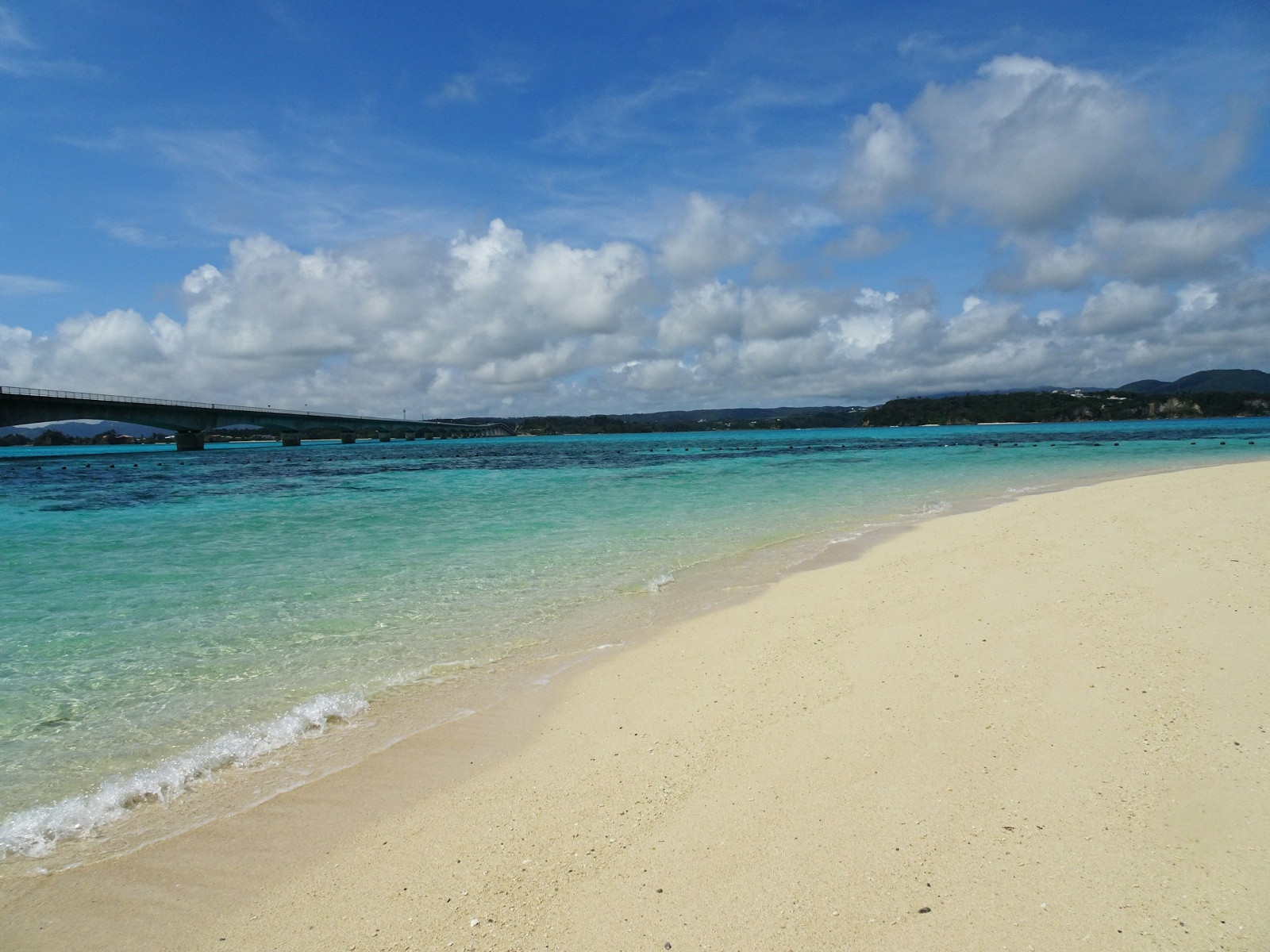
古宇利島 (Kouri Island) is a small, round island of about 8 km around off the northern coast of the Motobu Peninsula in Nakijin, northern Okinawa. Since 8 February 2005 it has been joined to Yagaji Island, and so to the main island, by the 古宇利大橋 (Kouri Bridge), 1,960 metres long and free to cross, whose low span over pale turquoise shallows is one of the classic drives of Okinawa. Beside the island end of the bridge lies 古宇利ビーチ (Kouri Beach), a stretch of white sand with clear, calm water where the swimming season runs from about late April to late October, though facilities are simple and there is generally no lifeguard. Islanders call Kouri an island of love, because in an old creation story, often compared with Adam and Eve, a young man and woman came down from heaven and lived here on rice cakes that fell from the sky, until they began to store them, the cakes stopped, and they learned to work the land and became the ancestors of the Ryukyuan people. On the north coast, ティーヌ浜 (Tinu Beach) has two rocks that look like hearts from the right angle, and a road of about 8 km circles the island past fields of sugar cane and small viewpoints. 古宇利オーシャンタワー (Kouri Ocean Tower) offers a view 82 metres above the sea and a shell museum, for ¥1,000 for adults, from 10:00 to 18:00. Late spring, from April into early May, is a good time to come, with the beach season starting and the rainy season, which usually begins around 10 May, not yet arrived. The island is about 1 hour 30 minutes to 2 hours by car from Naha by the Okinawa Expressway to Kyoda, and is easily combined with Nakijin Castle and the Churaumi Aquarium on the Motobu Peninsula.
Naminoue Shrine (波上宮)
Okinawa's foremost shrine, set on a cliff above Naminoue Beach near central Naha.
Naminoue Shrine (波上宮) is Okinawa's top ranking shrine and the first of the historic Ryukyu Eight Shrines, set on an uplifted coral limestone cliff on the western edge of Naha so that the vermilion main hall with its red tiled roof and white walls stands directly above the sea, with the name meaning "above the waves" and the site having served as a sacred place since long before Shinto arrival when it was dedicated to Nirai Kanai, the mythical sea god realm of the indigenous Ryukyuan religion. The main hall is guarded not by the usual komainu but by Shisa lion statues in the Okinawan style, with the male on the right with open mouth bringing in good fortune and the female on the left with closed mouth keeping out misfortune. The site was completely destroyed in the 1945 Battle of Okinawa and rebuilt with the main hall in 1953 and the remaining buildings by 1993, with the current structures preserving the prewar Okinawan vermilion style. Naminoue Beach directly below the cliff is the only beach in central Naha City and is part of the Naminoue Umisora Park, free to enter and open year round, with mild spring weather from late March making the clifftop walk and beach combination one of the most accessible coastal outings in the city. The shrine is free to enter, around 10 minutes' drive from Naha Airport or a 15 minute walk from Yui Rail Asahibashi Station.
Experiences in Kyushu
These are the spring experiences and events worth building a Kyushu visit around.
Experiences in Okinawa
These are the spring experiences and events worth building an Okinawa visit around.
Prefecture map
Food in Kyushu
Spring arrives in Kyushu before it reaches the rest of the country and the food follows it up. Bamboo shoots come out of the ground with the blossom front, Saga lifts its new onions, the sea bream move inshore to spawn, and Fukuoka's strawberry season runs on into April.
Strawberry
Fukuoka's own variety, grown nowhere else, with the season running on into April.
あまおう (Amaou) is grown only in Fukuoka, across seventeen local JA cooperatives, and the name is built from the first letters of 甘い, 丸い, 大きい and 美味い. The season opens in November and runs to April or May, so spring is the tail of it rather than the peak, and the fruit is easier to find and cheaper by then. Fukuoka Prefecture reports that 博多あまおう has held the highest sales unit price of any strawberry in Japan for eighteen years running. The variety's formal name is 福岡S6号. Through the spring it turns up in everything from parfaits to daifuku across the prefecture, and the pick your own farms around Kurume and Yame stay open into April.
Flying fish
Kagoshima's toppi, landed at Tanegashima and Yakushima from March to May, eaten as sashimi or one night dried.
トビウオ (Tobiuo) is called トッピー (toppi) in Kagoshima, and the prefecture takes over seventy per cent of the national catch, most of it landed around 種子島 (Tanegashima) and 屋久島 (Yakushima). The season runs from March to May. The fish glides above the surface for a hundred metres or more on its outsized pectoral fins to escape whatever is chasing it, and the flesh has the texture that this suggests. It is firm, lean and springy rather than soft. It is eaten as sashimi when it is fresh enough, which on the islands it is, and otherwise as 一夜干し (ichiya boshi), salted and dried overnight then grilled, or ground into surimi for 揚げ天. The high speed ferries from Kagoshima to the islands are named after it, which is a fair indication of how closely the fish and the place are tied together.
New onions
Saga's early onions, lifted from February and sold unstored, mild enough to eat raw.
新玉ねぎ (Shin Tamanegi) are the early crop lifted between February and June and sold without the drying and storage that ordinary onions get, which leaves them soft, high in water and sweet enough to eat uncooked. Saga is the second largest onion producer in Japan after Hokkaido, and Shiroishi Town alone accounts for close to 70 percent of the prefecture's crop. The early varieties grown there include スイートハート and 春一番. Sliced thin and dressed with bonito flakes and soy they are a dish in their own right rather than a base ingredient, and roadside stands across the Shiroishi plain sell them by the net through the spring.
Spring sea bream
Genkai Sea bream at their fattest as they move inshore to spawn, through March and April.
Spring sea bream is 真鯛 (madai) caught in the 玄界灘 (Genkai Sea) off Saga in March and April, when the fish move into shallower water to spawn and carry the most fat of the year, and the name comes from the pink flush the skin takes on at that season. They are landed at Yobuko by ごち網 net and by hand line, with the largest fish kept alive in tanks for auction. The bream is Karatsu's emblem, and the fifth float of the 唐津くんち, built in 1845, is a sea bream. Saga's treatment is 鯛の姿煮 (Tai no Sugatani), the whole fish simmered in soy, sugar and ginger and served with the head and tail intact, which is a celebration dish rather than an everyday one. Kanto takes the same fish as chazuke, Chugoku cooks it through rice and Tokushima simmers it in pieces.
Mustard greens
Fukuoka's Miike takana, cut in early April and salted down into the pickle that flavours half of Kyushu.
Takana is sown in late September, transplanted through December and harvested in early April at 瀬高 in Miyama City, grown as a second crop in the rice paddies on contract to the pickle makers. The local variety is 三池高菜 and the planted area once reached 1,000 hectares. Traditional ageing under a heavy salt content darkens it to a 鼈甲色 tortoiseshell colour over months. The finished pickle is what goes into 高菜チャーハン, what sits in a pot on the counter of every tonkotsu ramen shop in the prefecture for you to add by the spoonful, and what fills 高菜めし down in Aso.
Food in Okinawa
Spring in Okinawa is harvest season for two things the islands are known for and the mainland barely grows. These are shima rakkyo out of the sandy northern fields, and mozuku pulled off the nets in the shallows inside the reef.
Island scallion
Small pungent scallions dug from the sandy fields between January and May, salted or fried whole.
島らっきょう (Shima Rakkyo) are harvested from January to May and reach the market through the spring and into early summer. They are grown across the north of the main island, in Miyakojima and the surrounding islands, and on 伊江島 (Ie Island), the area most associated with them, across roughly 76 to 84 hectares producing between 655 and 720 tonnes a year. They are far smaller and much sharper than mainland rakkyo, and the standard treatments are a light salt pickle eaten with the green tops still attached, or battered whole and fried as tempura. Every izakaya in Naha has them on the first page of the menu through the spring.
Mozuku seaweed
Fine brown seaweed pulled off the nets in the shallows from March to June, eaten cold in vinegar.
もずく (Mozuku) is harvested between March and June by suction pump from nets seeded the previous autumn in the shallow water inside the reef. Okinawa produces around 90 per cent of Japan's mozuku, and Uruma City alone accounts for roughly 40 per cent of the prefecture's share. Farmed mozuku was first harvested successfully in 1977 by a research group at the 恩納村漁協 fishing cooperative. It is slippery and fine stranded and is most often served cold in a vinegar dressing as もずく酢, but it is also fried into fritters as もずく天ぷら and cooked through soup. Spring is when it turns up fresh rather than packaged.