Confirm your email to unlock saving, sharing and exporting. We sent a link when you signed up.
Summer region guide
Kansai in Summer
Setting the Scene
General Feeling of the prefecture
Kansai in summer is hot, humid, and relentlessly so. Kyoto in particular sits in a basin geography that traps heat and moisture through July
and August, producing temperatures that regularly climb into the mid to upper thirties with a humidity level that makes the air feel thick
and heavy from the moment you step outside. It is frequently cited as one of the most uncomfortable urban summer climates in Japan, and that
reputation is earned. Osaka shares much of the same conditions, and while the coastal areas of Hyogo and Wakayama catch occasional sea breezes
that take the edge off, the lowland heat is a constant presence across the region through the peak summer months.
That reality shapes how summer in Kansai is best approached rather than whether it is worth visiting at all. The early morning hours before the
heat builds are beautiful. Temples and gardens that are packed with visitors by mid morning feel entirely different at dawn. The middle
of the day is best spent indoors, and Kansai has plenty of options for that, with museums, covered shopping arcades, and indoor attractions spread across
Osaka and Kyoto handling the hottest hours well. Evenings bring some relief and a distinct energy, particularly in Osaka where the summer night atmosphere
along the river and in the entertainment districts has a character all of its own.
Clothing for Kansai's summer is simple. Keep it light, breathable, and as minimal as you are comfortable with. Sun protection matters given how much time
is spent outdoors across the region's open temple grounds and walking streets. A portable fan, a small towel, and cold drinks within easy reach shift
from optional to useful pretty quickly. The rainy season clears Kansai in June before the full summer heat takes hold, though afternoon
thunderstorms are common through August and a compact umbrella is worth keeping on you.
Summer is busy across Kansai's major destinations, driven by domestic tourism, school holidays, and the region's festival calendar. Accommodation in
Kyoto and Osaka fills up and prices stay elevated through the peak months. The outer prefectures of Wakayama, Mie, and rural Hyogo offer a quieter
alternative, cooler in places, less crowded in most, and shaped more by coastline, mountains, and everyday local life than the concentrated tourism
of the two headline cities.
Beyond the capital
Exploring the Kansai Region
Summer in Kansai is hot and humid across the lowland cities but the region's geography provides natural escape routes, the mountain temples of Wakayama, the cool highland above Kobe, the ancient pilgrimage forests of the Kii Peninsula, and the lakeside of Biwa all offer alternatives to the city heat that are specific to the Kansai region and worth seeking out through July and August. The spots below cover both the city and the wider regional summer experiences.
Kyoto · Kyoto
Kibune Shrine (貴船神社)
A vermilion shrine to the water deity at the head of the Kibune valley, its lantern lined stone steps rising through the forest north of Kyoto.
Kifune Shrine (貴船神社) in the narrow mountain valley of Kibune in the northern hills of Kyoto is the head shrine of around 2,000 water god shrines across Japan with over 1,300 years of history, dedicated to the water deity Takaokami-no-Kami and entered through a flight of stone steps lined with vermilion lanterns leading up through the cedar forest to the Hongu main hall, with the Okumiya inner shrine deep in the forest at the original founding site of the shrine and a Mizu-ura water fortune ritual that reveals printed text only when the paper is dipped in shrine water. The valley's Kawadoko (川床) season runs from May 1 to September 30, the dates it kept in 2026, though individual restaurants set their own start and finish. Through those months the establishments lining the Kibune River build the wooden dining platforms directly over the surface of the flowing water, close enough to it that the air rising off the river keeps the valley around 10 degrees cooler than central Kyoto on hot summer days. The platforms are far younger than the shrine and date only to the Taisho era, when a Kibune teahouse set benches out at the river so that guests could cool their feet in it, a habit that grew into the full dining service of today. The kawadoko menus centre on summer river specialities including salt grilled ayu sweetfish and hamo pike conger served in kaiseki courses, with restaurants ranging from casual nagashi-somen at Hirobun, which charges ¥2,000 a head and takes no bookings for it, to upmarket traditional kaiseki where a reservation is needed. From Kyoto's Demachiyanagi Station the Eizan Electric Railway runs to Kibuneguchi Station, with Kyoto Bus 33 from there reaching the Kibune stop in around 5 minutes for the start of the riverside walk and shrine path.
AccessApproximately 30 minutes by Eizan Electric Railway from Demachiyanagi Station to Kibuneguchi Station, then approximately 20 minutes on foot or by bus to the shrine
A 3.6km pine covered sandbar across Miyazu Bay on the Sea of Japan, one of Japan's three great scenic views, crossed on foot or by bicycle.
A day at Amanohashidate (天橋立) in northern Kyoto Prefecture takes in one of Japan's Three Scenic Views alongside Matsushima in Miyagi and Miyajima in Hiroshima from the two elevated viewpoints on either side of Miyazu Bay, with Amanohashidate View Land (天橋立ビューランド) on the south side accessed by chairlift or monorail near Amanohashidate Station and offering the view of the sandbar as a flying dragon ascending to heaven, and Kasamatsu Park (傘松公園) on the north side accessed by chairlift or cable car and the place where the traditional Matanozoki upside down viewing through the legs was first practised. The pine covered sandbar itself crosses the mouth of the bay between the two viewpoints with around 5,000 pine trees lining the strip including the named Meoto Matsu Couples Pine and Chie no Matsu Wisdom Pine, and can be walked in around 50 minutes or cycled in around 20 minutes between the two ends. Beach swimming from mid July to August on the white sandy shores on either side of the sandbar pairs naturally with the viewpoint visits. Chionji Temple at the south end and Motoise Kono Shrine at the north end add cultural stops. From Kyoto Station the Kyoto Tango Railway runs to Amanohashidate Station in around 2 hours.
General information
AddressMonju, Miyazu-shi, Kyoto-fu 626-0001
AccessApproximately 2 hours by limited express train from Kyoto Station on the JR San'in Main Line to Amanohashidate Station
A white silica sand beach on the Wakayama coast, sheltered for swimming, with open air hot spring baths along the shore.
Shirahama (白浜) on the west coast of the Kii Peninsula in southern Wakayama is one of the top beach resorts in the Kansai region with Shirarahama Beach (白良浜) at its centre, a crescent of fine white sand made up of 90 per cent quartz that gives the beach an unusually pale colour by Japanese standards and led to its formal sister beach designation with Hawaii's Waikiki in 2000. The dramatic Sandanbeki Cliffs (三段壁) along the coast immediately south of the beach drop sheer to the Pacific with caves at the base accessible by elevator to a shrine and tunnel network once used by the historical Kumano Navy, and the Senjojiki tiered sandstone rock platform and the Engetsu Island arch with a circular hole eroded through its centre complete the dramatic coastal landscape around the beach. Shirahama is also one of Japan's Three Ancient Hot Springs alongside Arima in Kobe and Dogo in Matsuyama, with over 1,350 years of recorded history including mentions in the Manyoshu and Nihon Shoki, and public bathhouses including Saki-no-yu set into the wave beaten rocks overlooking the Pacific. Summer brings beach swimming, beach fireworks on selected evenings and the Sand Festival. From Shin-Osaka Station the JR Limited Express Kuroshio runs to Shirahama Station in around 2 hours 30 minutes, with a 15 minute bus from the station to the Shirarahama beach stop.
AccessApproximately 2 hours 30 minutes by limited express train from Shin-Osaka Station on the JR Kuroshio service to Shirahama Station, then approximately 15 minutes by bus to the beach
EntryFree
HoursOpen at all times, swimming season May to August
ParkingPaid car parks nearby, around ¥2,000 on festival days
Phone+81 739 43 6588
Koya · Wakayama
Koyasan (高野山)
A mountain temple town founded by Kukai, the centre of Shingon Buddhism, with over 100 temples and the forested Okunoin cemetery.
A night at one of around 52 shukubo (宿坊) temple lodgings on Koyasan (高野山) in northern Wakayama gives visitors the chance to share a temple with Buddhist monks for around ¥10,000 to ¥20,000 per night with two shojin ryori vegetarian meals, with attendance at the 5am morning prayer service in the temple's hondo and some temples adding optional meditation or sutra copying sessions. The wider Koyasan town sits on a small highland plateau between eight surrounding peaks of the Kii Mountain Range and was founded by the monk Kukai in 816 as the centre of the Shingon Buddhist sect, registered in 2004 as part of the UNESCO "Sacred Sites and Pilgrimage Routes in the Kii Mountain Range" with around 117 temples now spread across the town. Okunoin at the eastern end of the town is the most sacred area, with a cedar forested approach past over 200,000 memorial stones and the graves of daimyo lords including Toyotomi Hideyoshi and Oda Nobunaga leading to Kukai's mausoleum where he is believed by the Shingon tradition to remain in eternal meditation. The cool highland air runs several degrees lower than the lowlands through the hot Kansai summer. From Osaka Namba Station the Nankai Koya Line runs to Gokurakubashi Station in around 1 hour 20 minutes followed by a cable car and bus up the mountain.
AccessApproximately 1 hour 30 minutes by Nankai Electric Railway limited express from Namba Station in Osaka to Gokurakubashi Station, then by cable car to Koyasan Station, then by bus into the temple complex
EntryTown free, temple halls around ¥500 to ¥1,000
The main pilgrimage route of the Kumano Kodo through the Kii mountains, a forested trail linking the three Kumano grand shrines.
The Nakahechi (中辺路) route of the Kumano Kodo (熊野古道) ancient pilgrimage network in the mountains of the Kii Peninsula in southern Wakayama runs from the Takijiri-oji trailhead through the mountain villages of Takahara and Tsugizakura over three days of walking to Kumano Hongu Taisha (熊野本宮大社), the head of the three Kumano Sanzan grand shrines, with a further two days continuing to Kumano Nachi Taisha (熊野那智大社) and the option of bus or train to Kumano Hayatama Taisha (熊野速玉大社) at the coast in Shingu. The wider network was registered in 2004 as part of the UNESCO "Sacred Sites and Pilgrimage Routes in the Kii Mountain Range" and is one of only two UNESCO listed pilgrimage routes in the world along with the Camino de Santiago in Spain, with the Nakahechi the most popular and accessible section walked for over 1,000 years by emperors, samurai, monks and ordinary pilgrims. The stone paved Daimon-zaka approach to Nachi Taisha climbs through moss covered towering cedar trees and the Nachi Waterfall behind the shrine drops in a single sheer fall that ranks as Japan's tallest single drop waterfall and one of the country's Three Great Waterfalls. The route is shaded by dense cedar forest through summer with pilgrim hot springs at Yunomine, Kawayu and Watarase offering bath stops. From Shin-Osaka Station the JR Limited Express Kuroshio runs to Kii-Tanabe Station in around 2 hours 15 minutes, with a 40 minute bus from there to the Takijiri trailhead.
General information
AddressTanabe-shi, Wakayama-ken
AccessApproximately 2 hours 15 minutes by limited express train from Shin-Osaka Station to Kii-Tanabe Station, then approximately 40 minutes by bus to the Nakahechi trailhead at Takijiri-oji
EntryFree
HoursOpen at all times, walk in daylight
ParkingCar parks at the main trailheads and shrines
Toyooka · Hyogo
Takenohama Beach (竹野浜)
About a kilometre of fine white sand and clear water on the Japan Sea coast of northern Hyogo, one stop from Kinosaki Onsen.
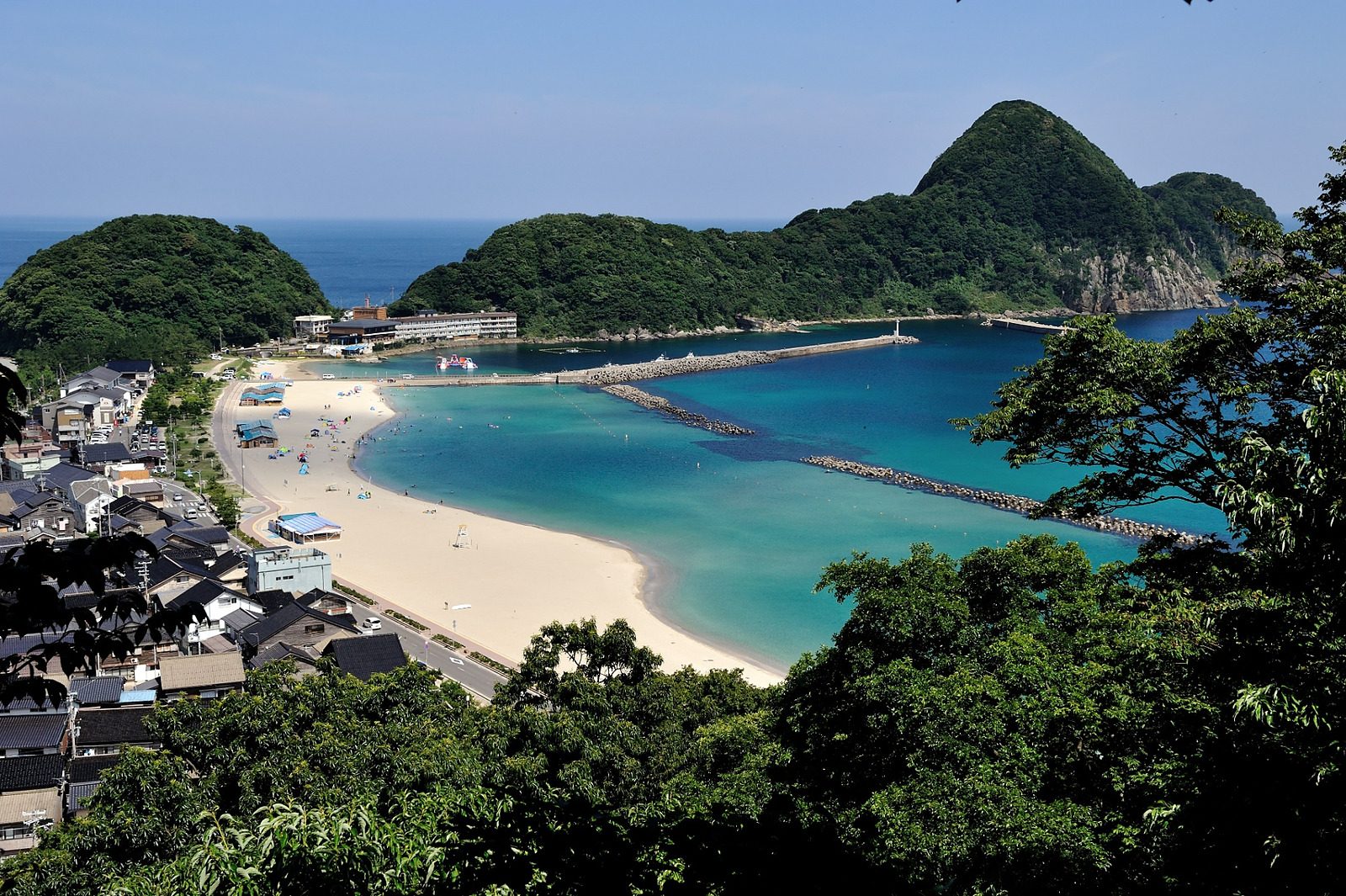
竹野浜 (Takenohama) is the beach of 竹野町 (Takeno-cho) in Toyooka City, on the Japan Sea coast of northern Hyogo, and about a kilometre of fine white sand backed by the old fishing town. The water is clear enough that it has been chosen for both the 快水浴場百選 (100 best swimming beaches) and the 日本の渚百選 (100 best shores of Japan), and the coast around it is a geosite of the 山陰海岸ジオパーク (San'in Kaigan UNESCO Global Geopark), with sea caves and rock formations along the shore on either side. At the eastern end the 猫崎半島 (Nekozaki Peninsula) shelters the bay, which is why Takeno served as a port where the 北前船 (Kitamae-bune) trading ships of the Edo period waited out bad weather. The swimming season ran from 1 July to 23 August in 2026, with lifeguards on duty from 8am to 5pm and 6 beach houses along the sand, where changing and showers cost about ¥1,000 for adults. The Takeno sea fireworks, held since 1970, are launched over the bay in late July. Takeno is one stop west of Kinosaki Onsen on the JR San'in Line, and the beach is about 15 minutes on foot from Takeno Station. Pairing a day on the sand here with a night in the bathhouse town of Kinosaki is the easiest way to see the Japan Sea side of Kansai in summer.
AccessApproximately 15 minutes on foot from Takeno Station on the JR San'in Line, one stop west of Kinosaki Onsen
EntryFree
HoursOpen at all times, swimming season 1 July to 23 August in 2026, lifeguards 8am to 5pm
ParkingAbout 1,450 spaces in season, ¥2,000 per day
Phone+81 796 47 1080
Summer moments
Seasonal Experiences and Events in Summer
Now that you have a sense of how the season runs here, these are the highlights and experiences worth building the trip around.
Prefecture map
Seasonal culture
Seasonal Food & Everyday Atmosphere
Summer in Kansai is a season shaped by heat and humidity, and the region’s food reflects that reality in a very deliberate way. As temperatures rise,
the focus shifts toward cooling dishes, lighter preparations, and ingredients that help make the climate more manageable. From Kyoto’s refined summer cuisine
to Osaka’s more casual street food culture and the coastal influences of Hyogo and Wakayama, it is a region with a strong culinary identity, and summer brings
out some of its most refreshing and carefully balanced flavours.
鱧 (Hamo)
Pike conger eel
Kyoto's Gion Matsuri fish, its fine bones cut through at a millimetre's spacing before it is cooked.
Summer hamo
鱧 (Hamo) is Kyoto's summer fish, and the reason it became one is that it survived the journey. Hamo is unusually hardy out of water, so in the centuries before refrigeration it was the only sea fish that reached the inland capital from the Inland Sea still alive, which is why a landlocked city built its summer cooking around it. The fish is full of fine bones that cannot be removed, so it is prepared by 骨切り (honegiri), laying the fillet skin down and cutting through the flesh at roughly one millimetre intervals without cutting the skin, which takes years to learn. The standard treatment is 湯引き (yubiki), a brief blanch that makes the scored flesh bloom open like a flower, chilled and eaten with 梅肉 (umeniku) plum sauce. It is so tied to 祇園祭 (Gion Matsuri) in July that the festival is locally called the hamo festival. Chugoku lands the fish. Kyoto made it a ritual.
賀茂なす (Kamo Nasu)
Kyoto eggplant
A round Kyoto heirloom eggplant in season through summer, often grilled with sweet miso as dengaku.
Kyoto round eggplant
A traditional Kyoto vegetable that comes into its own in summer. Larger and rounder than typical eggplant, kamo nasu has a dense texture and a slightly sweet flavour that holds up well to cooking. It is most famously prepared as 賀茂なす田楽, grilled and topped with a rich miso glaze, though it also appears simmered or lightly fried. It is a good example of how Kansai handles summer vegetables with simplicity and precision.
冷やしそうめん (Hiyashi Sōmen)
Chilled thin noodles
Miwa somen from Nara, where the noodle is said to have started, stretched by hand and eaten cold.
Chilled somen noodles
そうめん (Somen) is the thinnest of the wheat noodles and Kansai has the origin claim. 三輪素麺 (Miwa Somen) comes from Miwa in Sakurai, Nara, at the foot of Mount Miwa, where the noodle is traditionally said to have been made first, and it is still produced by 手延べ (tenobe), repeatedly stretching and folding a rope of dough by hand rather than cutting it, then hanging it to dry. Hand stretched somen is drawn finer than machine cut noodles and holds a firmer bite when chilled. It is boiled briefly, shocked in ice water and served over ice with a cold dipping broth, ginger and spring onion. The Nara version of the summer spectacle is 流しそうめん (nagashi somen), noodles sent down a split bamboo channel of running water to be caught with chopsticks as they pass, which the restaurants in the valleys around Sakurai and Yoshino set up outdoors through the summer.
水なす (Mizu Nasu)
Osaka water eggplant
An Osaka water eggplant so juicy it is eaten raw or lightly pickled, a speciality of the Senshu region.
Osaka water eggplant
A speciality of Osaka, particularly in the Senshu region. Mizu nasu is unusually soft and juicy, to the point where it can be eaten raw. It is most commonly prepared as a light pickle, where its natural sweetness and high water content create a refreshing, almost crisp texture that fits perfectly with summer.
土用の丑の日のうなぎ (Doyo no Ushi no Hi no Unagi)
Grilled eel
Grilled eel eaten around the Day of the Ox in midsummer, a Kansai tradition for stamina in the heat.
Summer eel, Doyo no Ushi
Grilled eel is eaten in high summer, particularly around 土用の丑の日 (Doyo no Ushi no Hi), on a long standing custom held to help combat fatigue caused by the heat. In Kansai, the preparation style differs slightly from Kanto, with the eel often grilled directly without steaming first, resulting in a firmer texture. It is rich, but intentionally eaten as a way to maintain energy through the season.
鮎 (Ayu)
Sweetfish
A river fish skewered and grilled whole over charcoal with salt, the centrepiece of Kansai's summer riverside cooking.
Salt grilled river fish
Ayu run the clear upland rivers of Kansai through the summer, and the season is set by the river rather than the calendar. On the 上桂川 (Kamigatsuragawa) at Keihoku in the northern hills of Kyoto, 友釣り (tomozuri), the decoy method in which a live ayu on a line provokes a territorial fish into striking, opened at 5am on June 20 in 2026. Fish caught on that stretch were sent to the imperial court from the founding of the Heian capital until the end of the Edo period and are still sold under the name 献上鮎 (kenjo ayu / tribute ayu). The other name for the fish, 香魚 (koyo / fragrant fish), comes from a melon like scent in the flesh that fades within hours of the catch. The standard treatment is 塩焼き (shioyaki), skewered whole in a curve, salted heavily on the fins and tail so they survive the fire, grilled over charcoal and eaten head to tail with the bitter gut left in. Small early season fish are eaten whole in a couple of bites, while later fish are fattier and often served as part of a kaiseki course. It is the fish that anchors the summer menus on the kawadoko platforms at Kibune and along the Kamogawa.
三輪素麺 (Miwa Somen)
Nara hand stretched noodles
Hand stretched wheat noodles from the Miwa district of Nara, made only in midwinter and eaten chilled all summer.
Nara hand stretched somen
Somen is eaten across Japan in summer, but the trade is centred on 三輪 (Miwa) in Sakurai City, Nara, at the foot of Mount Miwa. The tradition holds that more than 1,200 years ago the son of a priest at 大神神社 (Omiwa Shrine) sowed wheat in the district and made the first somen from it, and the shrine still holds a 卜定祭 (Bokujosai) each February at which the coming year's somen price is divined. The noodles are made only from December to the end of March, when the cold dry air suits a process that runs over two days. The dough is repeatedly stretched, twisted and rested in a stage called ウマシ (umashi) that drives off moisture, which is what gives the finished noodle its thinness, its firmness and its resistance to going soft in the pot. 三輪素麺 was registered as a protected geographical indication in March 2016. In summer it is boiled, shocked in ice water and served with a cold dipping sauce, and in winter the same noodles go into にゅうめん (nyumen), a hot broth version that is the everyday Nara way of eating them.
あら川の桃 (Arakawa no Momo)
Wakayama peaches
Wakayama peaches sold from roadside stands through high summer, with a relay of varieties running from late June into August.
Summer peaches from Kinokawa
The peach orchards of 桃山町 (Momoyama) in Kinokawa City in northern Wakayama supply あら川の桃 (Arakawa no Momo), which reach the stands as a relay of varieties rather than a single crop. Picking starts in the second half of June with 日川白鳳 (Hikawa Hakuho) and runs through 八幡白鳳 (Hachiman Hakuho), 白鳳 (Hakuho), なつっこ (Natsukko) and 清水白桃 (Shimizu Hakuto) to the late, large, firmer 川中島白桃 (Kawanakajima Hakuto) in early August, so the fruit on sale in mid July is a different peach from the fruit on sale three weeks later. The name was registered as a trademark in 1994 and as a protected geographical indication in July 2023. Most of the crop is sold locally rather than shipped. The JA Kinosato farm shop めっけもん広場 (Mekkemon Hiroba) opens at 9am in season and the peaches are generally gone soon after, which is why the roadside stands along the valley are the practical way to buy them. They are eaten plain and cold, and are at their best within a day or two of picking.
しば漬 (Shibazuke)
Kyoto summer pickle
Aubergine salted with the red shiso of Ohara and left to sour, the one of Kyoto's three traditional pickles that belongs to summer.
Ohara red shiso pickle
Of the three pickles Kyoto is known for, 千枚漬 (senmaizuke) and すぐき漬 (sugukizuke) are both made from late autumn onwards, and しば漬 (shibazuke) is the summer one. It is made in 大原 (Ohara), the mountain basin north east of the city, from summer aubergine, salt and the local 赤紫蘇 (akashiso / red shiso), left to sour through lactic fermentation over roughly two months with no vinegar added. The red shiso is the point. Ohara has grown it for around 800 years from seed saved locally, and the basin geography keeps the strain from crossing with outside varieties, while the day to night temperature swing and the summer mountain mist are credited with the colour and scent that make it worth the journey. The harvest peaks in July, and 寂光院 (Jakkoin) holds a 赤しそ法要 (Akashiso Hoyo), a service of thanks for the crop, on July 1. The name is written 紫葉漬, purple leaf pickle, and tradition has it that 建礼門院 (Kenreimon in), living out her retirement at Jakkoin, was given a jar of the villagers' pickled summer vegetables and named it herself.
Plan your trip
Book your stay in Kansai
Search accommodation across Kansai, from Kyoto and Osaka city hotels to Nara guesthouses and Koyasan temple lodgings. Compare options across the major booking platforms.
Ready to plan your Kansai trip?
Browse itineraries built around Kansai in summer, from the cool riverside of Kibune to the southern beaches of Shirahama.