Confirm your email to unlock saving, sharing and exporting. We sent a link when you signed up.
Winter region guide
Kansai in Winter
Setting the Scene
General Feeling of the prefecture
Kansai in winter is quieter, colder, and in many ways more accessible than at any other point in the year. The crowds that define spring and autumn
thin out considerably, accommodation prices drop, and the major temples, gardens, and historic streets of Kyoto can be experienced at a pace that the
busier seasons simply don't allow. For travellers who have flexibility in their timing, winter makes a practical and often underrated case for itself
across the region.
Temperatures through December, January, and February are cold but not extreme by Japanese standards. Kyoto sits in a basin that holds cold air
through winter nights, and morning temperatures can drop to around zero or below on the coldest days. Daytime highs are generally in the mid single
digits to low teens depending on the month, and while snowfall in the city centre is infrequent it does occur, and when it does, the effect across
Kyoto's historic districts is striking. Osaka sits slightly warmer and sees even less snow, and the coastal prefectures of Hyogo and Wakayama are milder
again. A solid coat, warm layers, and comfortable boots cover most situations across the lowland areas of the region without needing to overcomplicate
the packing.
The mountainous areas of Wakayama, the higher elevations of Hyogo, and parts of Mie experience proper winter conditions with more reliable snowfall
than the urban centres. These areas see few visitors in winter which makes them worth considering for travellers looking to get off the beaten path
during the quieter season. The Kumano Kodo pilgrimage routes in Wakayama take on a completely different character in winter, cold, still, and largely
empty in a way that makes the experience feel remote despite being within reach of the region's main transport connections.
Winter is the right time to visit Kansai if Kyoto is a priority and crowds are a concern. The city is still fully functioning, the temples
and gardens are open, and the experience of walking through Gion or along the Philosopher's Path on a cold, clear winter morning without the
shoulder to shoulder press of peak season is something that regular Kansai visitors often describe as their preferred way to see the city. It
requires a coat and some tolerance for the cold, but little else beyond that.
Beyond the capital
Exploring the Kansai Region
Winter in Kansai is cold, occasionally snowy across the highland areas and the northern parts of the region, and one of the more underrated seasons to visit a region that most travellers associate primarily with spring cherry blossoms and autumn foliage. The reduced crowds, the lower accommodation prices, and the specific winter character that snow and cold bring to some of the most celebrated historic sites in Japan give the season a genuine and compelling case for itself that the peak season months cannot make in the same way.
Kyoto · Kita
Kinkakuji Temple (金閣寺)
The Golden Pavilion in its gold leaf above its reflecting pond, at its most striking under a dusting of winter snow on the roof and surrounding garden, a rare and brief Kyoto sight.
Kinkakuji (金閣寺), officially Rokuonji Temple, is a Zen Buddhist temple in Kita-ku in northern Kyoto and one of the most visited historic sites in Japan, with the three storey Golden Pavilion at its centre covered in around 20 kilograms of gold leaf across the upper two floors and reflected in the still water of the Kyoko-chi Mirror Pond. The pavilion was originally built in 1397 as the retirement villa of the third Ashikaga shogun Yoshimitsu and converted to a Zen temple after his death in 1408, with the present structure rebuilt in 1955 after a fanatic monk burned the original down in 1950, and registered as a UNESCO World Heritage Site as part of the Historic Monuments of Ancient Kyoto. The garden surrounding the pavilion is a 14th century Pure Land stroll garden, with the Rikushu-no-Matsu pine one of Kyoto's three famous pines and the Anmintaku Pond and Sekkatei Teahouse further along the one way walking path. Kyoto receives only a handful of snowfalls each winter and the morning after a snowfall produces the defining seasonal image at the temple, with the white of the snow against the gold of the pavilion a combination the other seasons cannot replicate. The temple is open 9:00 to 17:00 daily for an admission of ¥500, and from Kyoto Station Kyoto City Bus route 205 reaches the Kinkakuji-michi stop in around 40 minutes for a 5 minute walk to the temple.
General information
Address1 Kinkakujicho, Kita Ward, Kyoto 603-8361
AccessKyoto City Bus 101 or 205 from Kyoto Station to the Kinkakuji-michi stop, around 40 minutes
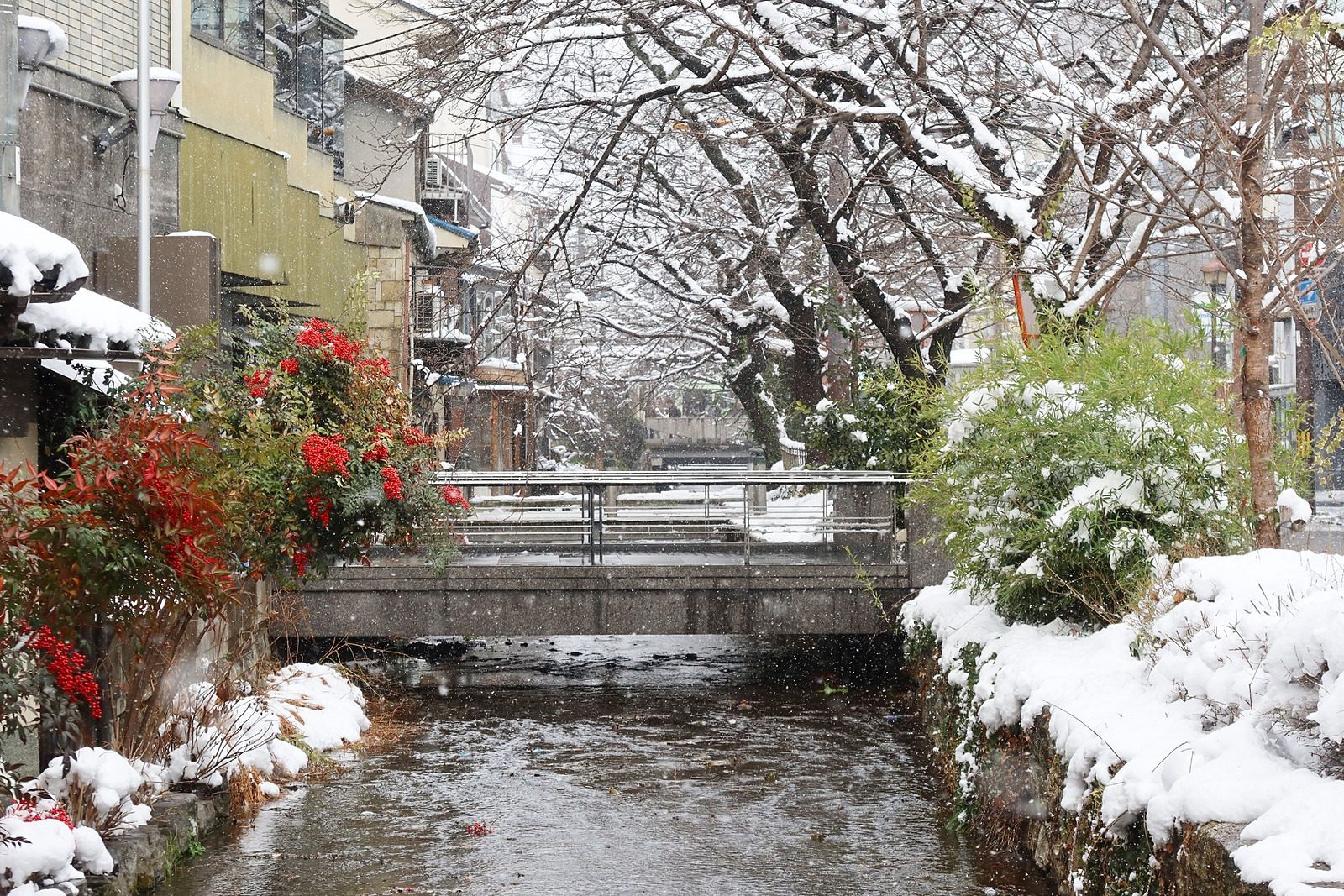
Snow settles on central Kyoto only on a handful of winter mornings, and when it does the vermilion halls of Heian Shrine and the great wooden gate of Nanzen-ji, 15 minutes apart on foot, become the classic picture of the old capital in white.
Okazaki, on the eastern edge of central Kyoto below the Higashiyama hills, holds two of the city's best snow views within a short walk of each other. 平安神宮 (Heian Shrine) was built in 1895 for the 1,100th anniversary of Kyoto's founding as the capital, its vermilion halls a scaled down copy of the Heian period imperial palace, and its giant torii straddles the avenue to the south. The shrine grounds are free and open 6:00 to 17:00 from November to mid February, and the Shin-en garden behind the halls costs ¥600, open 8:30 to 17:00. 南禅寺 (Nanzen-ji), to the southeast, is one of the head temples of Rinzai Zen, and its huge wooden 三門 (Sanmon) gate can be climbed for a view over the city for ¥600, with the Hojo and its dry garden another ¥600. The temple grounds themselves are free, and the red brick aqueduct built in the Meiji period to carry Lake Biwa water into Kyoto runs straight through them. From Nanzen-ji the canal path north toward the Philosopher's Path passes Shishigatani, where the stone paving and the water look their best under fresh snow. Snow in the city rarely lasts beyond late morning, so check the forecast the night before and go at first light. The Sanmon, the Hojo and Nanzen-in open 8:40 to 16:30 from December to February and close from 28 to 31 December.
HoursHeian Shrine 6:00 to 17:00 (November to 14 February), Nanzen-ji Sanmon and Hojo 8:40 to 16:30 (December to February), closed 28 to 31 December
ParkingPaid car parks in Okazaki
Kyoto · Sakyo
Kurama and Kibune (鞍馬・貴船)
Two mountain villages 30 minutes north of central Kyoto, joined by a trail over Mount Kurama, where snow falls more often than in the city and settles on the cedar forest, the red lanterns of Kifune Shrine and the gate of Yuki Shrine.
鞍馬 (Kurama) and 貴船 (Kibune) lie in neighbouring valleys in the forested hills north of Kyoto, at the end of the Eizan Railway from Demachiyanagi, about 30 minutes and ¥470 to Kurama. At Kurama the path climbs from the station past 由岐神社 (Yuki Shrine), the guardian shrine of the village, under a giant Kitayama cedar, to 鞍馬寺 (Kurama-dera), a mountain temple open 9:00 to 16:15 for ¥500, whose treasure house closes from mid December to February. From the main hall a trail of about 4 km crosses the ridge and drops into the Kibune valley, a walk of 1 to 2 hours that is steep in places and icy after snow, so wear boots with grip, or skip it and take the train one stop to Kibune-guchi and the bus up the valley. 貴船神社 (Kifune Shrine) is dedicated to the god of water, and its approach of stone steps lined with red lanterns is one of the most photographed sights in Kyoto, never more so than under snow. The riverside restaurants that serve meals on platforms over the stream in summer are quiet in winter. The valleys are noticeably colder than the city, and snow often lies here when central Kyoto has none, so the train north is worth taking on a cold morning even when the city is clear.
AccessEizan Railway from Demachiyanagi to Kurama, about 30 minutes and ¥470, or to Kibune-guchi and a bus up the valley
EntryKurama-dera ¥500, Kifune Shrine and Yuki Shrine free
HoursKurama-dera 9:00 to 16:15, treasure house closed mid December to February
Koya · Wakayama
Koyasan Danjo Garan (高野山 壇上伽藍)
The sacred temple plaza Kukai laid out first on the Koyasan plateau, the vermilion Konpon Daito pagoda and Kondo hall rising from deep snow in the heart of the Shingon mountain.
Koyasan Danjo Garan (高野山 壇上伽藍) in winter sees heavy snowfall settle across the highland temple precinct on the mountain plateau in northern Wakayama and the central training complex of Japanese Shingon Buddhism that was founded by the monk Kukai in 816, with the snow covering the wooden temple halls and the surrounding cedar forest and the visitor numbers reduced to a small fraction of the spring and autumn peak seasons. The Konpon Daito (根本大塔), the two tiered vermilion tahoto pagoda at the centre of the precinct that houses a statue of Dainichi Nyorai and a three dimensional mandala, is the most distinctive winter image at Koyasan with the deep red of the pagoda against the white of the surrounding snow. The Kondo (金堂) main hall housing the Yakushi Nyorai healing Buddha sits beside the pagoda, with both buildings open daily from 8:30 to 17:00 for ¥500 admission each. Koyasan was registered as a UNESCO World Heritage Site in 2004 as part of the Sacred Sites and Pilgrimage Routes in the Kii Mountain Range. An overnight stay at one of the 51 shukubo temple lodgings from around ¥10,000 to ¥20,000 per person with two meals gives access to the early morning Buddhist service and the night time lantern walk through the snow covered Okunoin cemetery to the mausoleum of Kobo Daishi. From Osaka the Nankai Koya Line from Namba Station to Gokurakubashi Station and the Koyasan Cable Car total around 2 hours.
General information
Address152 Koyasan, Koya, Ito District, Wakayama 648-0211
AccessNankai Koya Line to Koyasan Station, then Nankai Rinkan Bus to the Kondo-mae stop, around 10 minutes
The temple of flowers in the hills of Nara keeps a handful of peonies blooming in the depth of winter, each sheltered under its own small straw hood against the cold.
長谷寺 (Hasedera) is the head temple of the Buzan school of Shingon Buddhism, set on a wooded hillside at Hatsuse in Sakurai, and is known as the temple of flowers for the peonies that fill its grounds in spring, around 7,000 plants of about 150 varieties at the late April festival. In the coldest weeks of winter a few peonies are coaxed into flower out of season, each protected by a small conical hood of straw that keeps off the frost and snow, so the bright pink and red blooms stand out against the bare stone walls and winter grass of the temple garden. The long covered stairway of the Noborirou leads up to the main hall and its wooden stage looking out over the valley, quiet in winter compared with the spring crowds. The temple is open 9:00 to 16:30 from December to February, and entry is ¥500 for adults and junior and senior high school students and ¥250 for elementary school children. It is about a 15 minute walk from Hasedera Station on the Kintetsu Osaka Line.
General information
Address731-1 Hatsuse, Sakurai, Nara
AccessAbout 15 minutes on foot from Hasedera Station (Kintetsu Osaka Line)
Entry¥500 adults and junior and senior high school students, ¥250 elementary school children
Now that you have a sense of how the season runs here, these are the highlights and experiences worth building the trip around.
Prefecture map
Seasonal culture
Seasonal Food & Everyday Atmosphere
Winter in Kansai is a season defined by warmth and comfort. As temperatures drop, the region’s food shifts toward deeper flavours, slow cooked dishes, and ingredients that are designed to be both satisfying and restorative. From Kyoto’s refined winter cuisine to Osaka’s more casual dining culture and the coastal influences of Hyogo and Wakayama, it is a region with a strong culinary identity, and winter brings out some of its most comforting and well balanced flavours.
蟹 (Kani)
Crab
The Tajima coast crab season, eaten as a full course at a Kinosaki ryokan with the town outside in a yukata.
Winter Sea of Japan crab
Winter in Kansai means crab, and the Kansai version of it is an overnight trip rather than a market stall. 松葉ガニ (Matsuba Gani) is landed along the northern Hyogo coast, and the season runs from early November to the end of March. What the region built around it is the ryokan crab course, with the whole animal served through a sequence, raw as 刺し, grilled over coals as 焼き, dropped into a hot pot as しゃぶ, the brain and roe eaten from the shell, and finally the shell itself used to cook rice in. 城崎温泉 (Kinosaki Onsen) is where most people do it, a hot spring town on the Maruyama River where guests walk between seven public bathhouses in yukata and wooden geta between courses, and the crab boats land at nearby 津居山 (Tsuiyama). Tottori's version on the Chugoku page is graded and tagged. Hyogo's is a room, a bath and eight courses.
京野菜 (Kyo Yasai)
Kyoto winter vegetables
The heritage vegetables of Kyoto, from shogoin turnip to kujo leek, sweetened by the cold and central to the city's winter kaiseki and home cooking.
Kyoto heritage vegetables
Kyoto’s traditional vegetables take on a different character in winter, with varieties like 聖護院大根 and 金時人参 appearing more frequently. These vegetables are often used in simmered dishes and kaiseki cuisine, where their natural sweetness and texture are highlighted through careful, minimal preparation.
湯豆腐 (Yudofu)
Tofu hot pot
Soft tofu warmed in kombu broth at the temple restaurants of Nanzen-ji and Arashiyama.
Kyoto winter hot pot
湯豆腐 (Yudofu) is a Kyoto winter dish that consists of almost nothing, which is the point. Soft tofu is warmed, not boiled, in a light kombu broth in a pot at the table and lifted out with a slotted scoop into a dipping sauce of soy, citrus and grated ginger or spring onion. The dish came out of 精進料理 (shojin ryori), the meat free temple cooking of Kyoto's Zen monasteries, and the long established yudofu restaurants sit where that history is, around 南禅寺 (Nanzen-ji) in the eastern hills and in 嵐山 (Arashiyama), several of them in former temple precincts with gardens attached. Kyoto's soft water is the standard local explanation for the tofu itself, and the good shops make theirs on the premises. Eaten in a wooden room looking at a winter garden it makes sense in a way it does not on paper.
関西風おでん (Kansai style Oden)
Kansai oden
Kansai oden, known locally as kanto-daki, simmers daikon, beef sinew and fishcakes in a lighter, paler dashi than the eastern version, a staple in the cold.
Winter simmered pot
Kansai oden differs slightly from its Kanto counterpart, with a lighter, clearer broth that reflects the region’s preference for subtle flavours. Ingredients like daikon, tofu, and fish cakes are simmered slowly, creating a dish that is warming without being heavy.
粕汁 (Kasu-jiru)
Sake lees soup
A warming winter soup of sake lees with root vegetables and salmon or pork, turning the by product of brewing into a thick, gently alcoholic broth.
Sake lees winter soup
A winter speciality made using sake lees, this soup is rich, slightly creamy, and deeply warming. It often includes vegetables, tofu, and sometimes fish, and is particularly associated with Kyoto and Osaka during the colder months.
ぼたん鍋 (Botan Nabe)
Wild boar hot pot
Wild boar simmered in miso broth in the hills of Tanba-Sasayama, the sliced meat laid out on the plate in overlapping petals like a peony.
Tanba-Sasayama winter hot pot
Botan nabe is the winter dish of Tanba-Sasayama in inland Hyogo, a pot of wild boar and vegetables simmered in miso broth. The name comes from the way the sliced meat is arranged, fanned out in overlapping petals like a botan, or peony. The town's tourism association traces the name to the early Showa period and the plating style to the post war years, when local inns worked out the presentation the dish is now known for, and the dish was recognised in 2022 under the national 100-Year Food scheme. The season follows the hunting calendar, which opens on 15 November, so the pot is on inn and restaurant menus through the coldest months. The broth is traditionally made with red bean miso, though many places now blend in white rice miso.
浦村かき (Uramura Kaki)
Toba oysters
Oysters farmed in the sheltered inlets of the Shima Peninsula, landed from October and fattest after the new year, eaten by the trayful at the grill huts along the coast road.
Mie winter oysters
Uramura oysters are grown in Ono Bay off Uramura on the eastern side of the Shima Peninsula in Toba, where the ria coastline gives calm, nutrient rich water. Toba's tourism association says the harvest starts around October and that the oysters put on size from the new year through to about February, with the winter oyster season running roughly from November to the end of March. The stretch of the Pearl Road between Toba and Shima has enough grill huts along it to be known locally as the Oyster Road, and most of them work on an all you can eat basis with a time limit of 60 to 90 minutes at a fixed price, usually somewhere between ¥2,800 and ¥4,000 for an adult. You either grill your own over the coals or have the staff do it for you.
飛鳥鍋 (Asuka Nabe)
Nara milk hot pot
A Nara pot of chicken and vegetables simmered in milk and dashi, traced back to the Asuka period when milk first came into Japanese cooking.
Nara milk and dashi hot pot
Asuka nabe simmers chicken and vegetables in a broth of milk and dashi, giving a mild, faintly sweet pot that is an unusual thing to find in the Kansai repertoire. Nara City's tourism association traces it to the Asuka period, when milk first came into use in Japanese cooking and chicken was cooked in it, which is where the name comes from. The chicken and vegetables give the broth plenty of body, and the standard finish is to drop udon into what is left in the pot at the end. It turns up on menus around Nara Park and the old streets of the city through the cold months, and it is an easy order for anyone finding the region's other winter pots heavy going.
有田みかん (Arida Mikan)
Wakayama mandarins
The satsuma mandarins of the terraced Arida hillsides, shipped from early October to late February and eaten by the boxful through the cold months.
Wakayama winter citrus
JA Wakayama puts the prefecture first in Japan for mikan production, and the main growing district is Arida on the coast south of Wakayama City, where the groves run in terraces up the hillsides above the sea. The shipping season runs from early October to late February, working through the extra early, early, mid and late Unshu cultivars as the winter goes on, so the fruit on sale in January is not the fruit that was on sale in October. Arida City runs its own place of origin certification for fruit grown inside the city, with sampled batches required to average at least 12 degrees Brix and acidity of 1.0 per cent or below. Boxes appear in every supermarket and roadside stand in the region through the winter, and a kotatsu with a bowl of mikan on it is about as domestic a Japanese winter image as there is.
灘の新酒 (Nada no Shinshu)
New sake from Nada
Winter is brewing season along the Kobe coast, where the five Nada districts press the year's first sake and the breweries open their gates in late January.
Hyogo winter brewing season
Nada Gogo, the five brewing districts of Nishi go, Mikage go, Uozaki go, Nishinomiya go and Imazu go, runs along the coast between Kobe and Nishinomiya. The brewers' association describes Hyogo as the leading prefecture in Japan for sake production and Nada as the largest producing area within it. Sake is made in the cold months, so winter is when the tanks are working and the first pressings of the season reach the shops, and the association's event listings include a Nada Gogo brewery open day in late January. Brewery museums along the route, among them the Hakushika Sake Museum in Nishinomiya, stay open through the winter and sit within a short walk of the Hanshin line, which makes an easy half day out of a cold Kobe afternoon.
Plan your trip
Book your stay in Kansai
Search accommodation across Kansai, from Kyoto machiya and Osaka city hotels to Kinosaki and Arima onsen ryokan and Koyasan temple lodgings. Compare options across the major booking platforms.
Ready to plan your Kansai trip?
Browse itineraries built around Kansai in winter, from a snow dusted Kinkakuji to the silent mountain temples of Koyasan.