This page has been translated from Japanese. If anything is unclear, please get in touch.
Winter region guide

Shikoku in Winter

Setting the Scene

General Feeling of the prefecture

Winter is Shikoku's quietest season and the island wears it comfortably. The dramatic snowfall and harsh conditions that define winter in Tohoku or the Japan Alps don't apply here in the same way, the lowland areas and coastal prefectures remain relatively mild through December, January, and February, and the overall winter climate on Shikoku is manageable without the heavy preparation that colder regions demand. It is a season that suits travellers who want to move through the island at a slow pace without weather being a constant variable to plan around.

That said, the interior tells a different story. The mountain areas of Tokushima and Kochi see genuine winter conditions with snowfall that can make certain roads slow or inaccessible during heavy falls, and the higher sections of the 88 temple pilgrimage route become cold and difficult underfoot through the depths of winter. The Iya Valley in particular, which sits in a deep mountain gorge in Tokushima, accumulates snow through winter and takes on a stark, isolated character that is striking but demands more practical preparation than the coastal areas. A solid coat, warm layers, and boots with reliable grip cover the mountain interior adequately for most visitors.
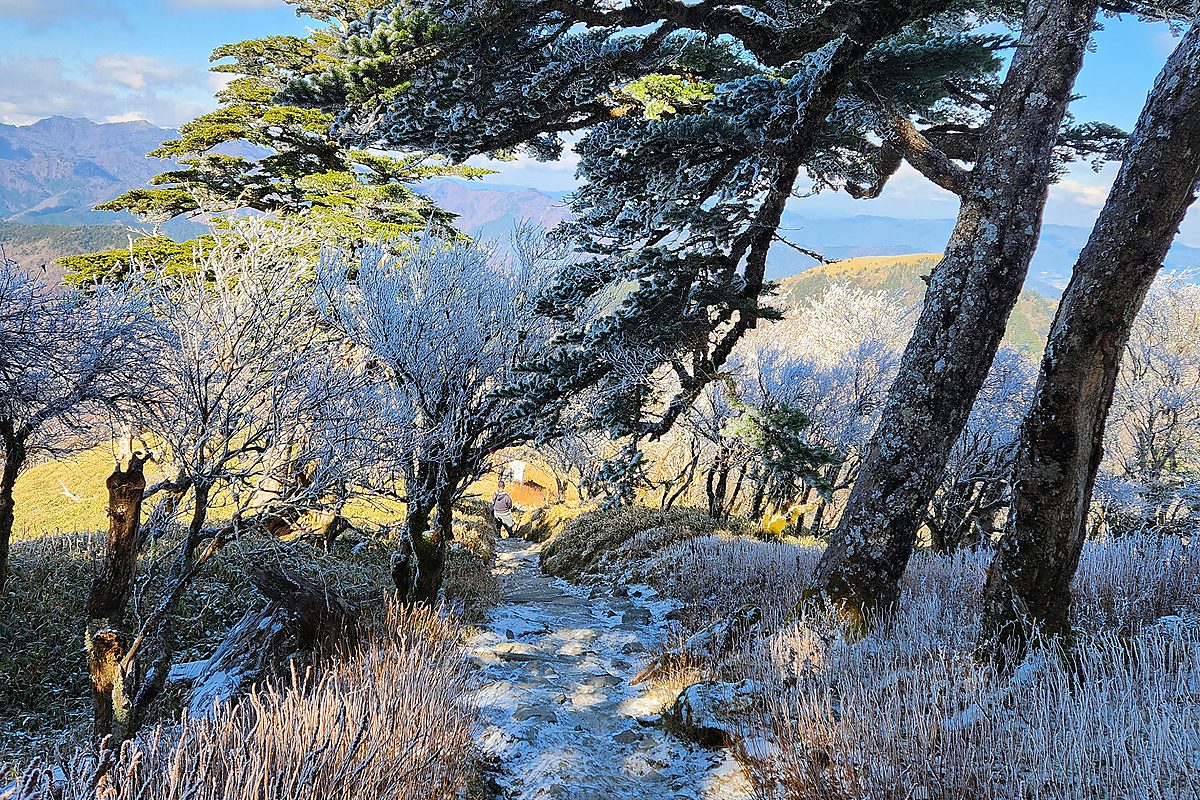
Frost covered trees and a rime coated stone path near the summit of Mount Tsurugi in Tokushima

The coastal prefectures are a different matter. Ehime on the Seto Inland Sea side has one of the milder winter climates in Japan, and Kochi on the Pacific coast is warmer in winter than much of the country. It is one of the few places in Japan where certain winter days feel almost mild by comparison to the national average. That warmth makes Kochi a practical and appealing winter destination for travellers who want to avoid the cold without sacrificing an authentic and off the beaten path experience.

Winter pilgrim numbers on the 88 temple route drop significantly through the coldest months, and the temple grounds across the island are correspondingly peaceful. Visiting in winter means engaging with the pilgrimage route and the island's cultural sites in their most unguarded state, with no crowds, no seasonal pressure, just the places themselves. Accommodation is easy to find and affordable across the island, and the practical business of getting around Shikoku in winter is simple as long as the mountain interior is approached with appropriate care.

Beyond the capital

Exploring the Shikoku Region

Winter in Shikoku is mild along the coastal areas and in the lowland cities, and considerably colder and snowier in the mountain interior, particularly in the Iya Valley and the highland areas of Tokushima and Kochi where the elevation and the mountain geography produce winter conditions that are remote and demanding. The combination of the hot spring culture, the pilgrimage tradition, and the specific winter landscapes of the island's interior gives the season a character that rewards those willing to move through Shikoku slowly and with some tolerance for the cold.

Matsuyama · Ehime

Dogo Onsen Honkan (道後温泉本館)

Japan's oldest hot spring, its grand three storey wooden bathhouse from 1894 at the heart of Dogo, the steaming baths most welcome in the cold and the building lit against the winter evening.

Dogo Onsen Honkan (道後温泉本館) is at its best from December through February when the temperature differential between the cold winter air outside the 1894 wooden bathhouse and the hot spring water inside is at its sharpest, the steam from the hot water condenses heavily in the cold air around the building, the wooden three storey Honkan is lit against the early winter evening sky from around 17:00, and the peak season queues at the bathhouse at the centre of what is considered Japan's oldest hot spring resort in Matsuyama in Ehime drop substantially. The Honkan, designated an Important Cultural Property in 1994, reopened in full on 11 July 2024 after five and a half years of preservation work carried out while part of it stayed open. The Dogo Haikara-dori shopping arcade leading from Dogo Onsen Station to the Honkan is busy through winter with visitors in yukata walking between the Honkan, the Asuka-no-Yu annex opened in 2017 next door, and the simpler Tsubaki-no-Yu opened in 1953, all three of which draw water from the same source. Honkan admission starts at ¥700 for the Kami-no-Yu bath, open 6:00 to 23:00 with last entry at 22:30, with dearer courses that add the Tama-no-Yu bath and the upstairs rest rooms. The Asuka-no-Yu starts at ¥610 for the basic bath, and the Tsubaki-no-Yu is the cheapest of the three. From Tokyo the most direct route is by flight to Matsuyama Airport and a 35 minute Limousine bus to Dogo Onsen.

General information
Address5-6 Dogo Yunomachi, Matsuyama City, Ehime 790-0842
AccessAround 25 minutes by tram from JR Matsuyama Station to the Dogo Onsen terminus, then a short walk
EntryFrom ¥700
Hours6:00 to 23:00
ParkingPaid car parks nearby
Phone+81 89 921 5141
Saijo · Ehime

Mount Ishizuchi (石鎚山)

The highest peak in western Japan at 1,982 metres, a sacred mountain reached in part by the Ishizuchi ropeway, its chain assisted faces snow covered and serious through the winter months.

Mount Ishizuchi (石鎚山) in Saijo City in Ehime, at 1,982 metres the highest mountain in western Japan and one of Japan's Seven Holy Mountains and 100 Famous Mountains, hosts Ishizuchi Ski Resort (石鎚スキー場) from late December to early March with the upper slopes operating as a ski and snowboarding resort and the surrounding forest covered in juhyo frost formations on the trees in the same period. The Ishizuchi Tozan Ropeway runs all year from Sanroku Shimodani Station at 455 metres to Sancho-Joju Station at 1,300 metres in an 8 minute ride for ¥1,200 one way or ¥2,200 return, providing access to the snow resort and views of the ice covered forest and the snow capped Tengudake summit ridge above. Joju Shrine, the middle shrine of the four in the Ishizuchi Shrine complex, sits around 20 to 25 minutes' walk above the upper ropeway station at 1,450 metres and remains open through winter, with the largest visitor numbers on New Year's Day for hatsumode. Mount Ishizuchi has been a centre of Shugendo mountain asceticism since the ascetic En no Gyoja opened it, and the walk to the summit passes four chain sections, the 74 metre Tameshi-no-Kusari and then the first, second and third chains below the top, each with a stairway detour for anyone who would rather not haul themselves up the links. The summit shrine and the lodge beside it are staffed from 1 May to 3 November, and the mountain's opening festival, the お山開き大祭 (Oyama-biraki Taisai), runs from 1 to 10 July. Snow lies on the upper mountain from December into late May, and both Saijo City and the summit lodge tell winter climbers that an ice axe and crampons are the minimum, that the stairway beside the third chain fills with snow until there is nothing left to hold, and that a climbing plan should be filed before setting out. The lodge shuts for the winter and leaves an unstaffed emergency shelter below the shrine, so the chain assisted summit routes are not a general winter outing. From Tokyo Station the Tokaido and Sanyo Shinkansen to Okayama Station and the JR Shiokaze Limited Express to Iyo-Saijo Station take around 5 hours total, with a Setouchi Bus from Iyo-Saijo to the Ishizuchi Ropeway-mae stop taking around 1 hour at ¥970 with only four buses daily. Opposite the ropeway base station, the Kyoya inn opens its cloudy white bath to day visitors from 10:00 to 17:00 with last entry at 16:30, at ¥500 for adults and ¥300 for children, which is the obvious way to end a cold day on the mountain.

General information
AddressNishinokawa Shitanikō 81, Saijo City, Ehime 793-0215 (ropeway base)
AccessAround 55 minutes by Setouchi bus from JR Iyo-Saijo Station to the Ishizuchisan Ropeway-mae stop
EntryRopeway fare required
HoursRopeway 8:40 to 17:00 from November to March, departures at :00, :20 and :40
ParkingPaid car park at the base
Phone+81 897 59 0331
Otsuki · Kochi

Kashiwajima Island (柏島)

A small island off the southwestern tip of Kochi, linked to the mainland by two bridges, its water famously clear and the diving reefs at their most transparent in the cold winter season.

Kashiwajima (柏島) at the southwestern tip of Kochi in Otsuki Town is a small fishing island of around 4 kilometres' circumference connected to the mainland by two bridges and known for the emerald coloured water of exceptional clarity at the confluence of the Kuroshio Current and the Bungo Channel, with the surrounding waters home to more than 1,000 species of fish or around a third of all species recorded in Japanese waters. The summer peak season for diving and snorkelling drops away through winter when the strong northwesterly winds across the Bungo Channel regularly cancel boat dives and put some of the outer sites out of use for the season, although the dive shops themselves stay open through the year and the water is at its clearest from autumn into winter, giving the small island village a notably quieter and more local character with the working fishing community of Kashiwajima Port at its most actively visible. The sea holds at around 18 to 20°C through the winter months, mild for a Japanese dive in February, and local guides report nudibranchs becoming easier to find from autumn onward and shoals of kibinago driven up by bonito. Maehama on the southern side is the site that stays workable when the northwesterly blows hard enough to close the others. The clear water of the Kashiwajima Bridge area produces the "floating boats" effect in the winter sunlight, with the village walk past old houses, temples and the small Inari Shrine taking around 30 minutes for a full circuit. The Odoyama Observatory on the mainland gives the panoramic view of the island and surrounding Pacific Ocean. From Kochi Station the JR Dosan Line to Kubokawa Station and the Tosa Kuroshio Railway to Sukumo Station total around 2 hours 20 minutes, with Kochi Seinan Kotsu buses from Sukumo to Kashiwajima taking around 1 hour in two legs and a change at the Michi-no-Eki Otsuki stop, on only a few services a day, for a total of about 3 hours 30 minutes of travelling before any waiting at the connections.

General information
AddressKashiwajima, Otsuki Town, Hata District, Kochi 788-0343
AccessAround 2 hours 20 minutes by rail from JR Kochi Station to Sukumo Station, then around 1 hour by bus with a change at Michi-no-Eki Otsuki, or around 45 minutes by car or pickup
EntryFree to visit
HoursDaylight hours
ParkingLimited island parking
Phone+81 880 62 8133
Official infoOtsuki tourism site
Winter moments

Seasonal Experiences and Events in Winter

Now that you have a sense of how the season runs here, these are the highlights and experiences worth building the trip around.

Prefecture map

Seasonal culture

Seasonal Food & Everyday Atmosphere

Winter in Shikoku is mild compared to most of Japan and the island handles the cold season without the drama of the northern regions. The food that defines it is warming and seasonal without being built around the survival imperative that shapes winter eating in Tohoku or Hokkaido. It is a comfortable and rewarding season to eat through the island and a few of the winter ingredients and traditions here are specific to Shikoku in ways that make them worth seeking out.

あん餅雑煮 (An Mochi Zoni)

Sweet bean mochi soup

Kagawa's New Year zoni, a white miso soup with an unusual sweet twist, the mochi filled with red bean paste, a regional take found nowhere else in Japan.

Kagawa New Year soup

あん餅雑煮 (An Mochi Zoni) is Kagawa's New Year soup and it exists essentially nowhere else. The rest of Japan eats 雑煮 (zoni) with plain mochi in a clear or miso broth. Kagawa puts a mochi filled with sweet red bean paste into a white miso soup with daikon and carrot, so the first mouthful is savoury and the second is dessert. The usual local explanation is economic. Sugar was a controlled Sanuki domain export in the Edo period, too valuable for farmers to keep, so putting bean paste in the New Year soup was the one day a year a household used its own sugar. It is eaten on New Year's Day and through the first days of January, mostly at home, though a handful of udon shops and hotels in Takamatsu serve it through the period. Reactions from outside the prefecture are reliably divided, which Kagawa appears to enjoy.

伊予柑 (Iyokan)

Iyokan citrus

The Iyokan citrus of Ehime, a sweet juicy mandarin orange hybrid in season through winter, the prefecture growing more of it than anywhere else in Japan.

Ehime winter citrus

伊予柑 (Iyokan) is Ehime's own citrus and the prefecture grows the great majority of the national crop. It is larger than a mikan with a thicker, looser skin that peels by hand, and the flesh is juicy and aromatic with more acidity behind the sweetness than a mandarin has. Peak season is January and February. The name comes from 伊予, the old name for Ehime, although the variety was actually found in Yamaguchi in the 1880s and moved here, which the prefecture is relaxed about. Ehime grows more citrus overall than any other prefecture and runs a long harvest calendar through the winter, so iyokan sits alongside 紅まどんな (Beni Madonna), a jelly fleshed variety eaten with a spoon, and 甘平 (Kanpei). Roadside stands and the 道の駅 along the Uwa coast sell them by the box, and the juice stands at Matsuyama airport pour them straight.

鍋焼きラーメン (Nabeyaki Ramen)

Clay pot ramen

Susaki's ramen served in an earthenware pot, the broth still boiling when it reaches the table, which is rather the point of it on a cold day.

Kochi, served in a clay pot

鍋焼きラーメン (Nabeyaki Ramen) is the local ramen of 須崎 (Susaki) on the Kochi coast and the vessel is what defines it. Susaki City describes it as a chicken bone and soy broth with thin firm straight noodles, spring onion, chikuwa and a raw egg cracked in, served in an earthenware donabe with pickles alongside. The pot solved a practical problem at Taniguchi Shokudo, the post war shop the dish is traced to, where deliveries in ordinary bowls arrived cold, so the owner switched first to enamel and then to clay to keep the heat in. It is eaten all year, but the format belongs to winter. The soup is still boiling when it is put down in front of you and stays that way to the last mouthful, which is the entire argument for it on a cold day. Susaki sits west of Kochi City on the JR Dosan Line and the shops are clustered around the town centre.

鯛めし (Taimeshi)

Sea bream rice

Ehime's two ways with sea bream and rice, one baked whole in the pot around Matsuyama and one served raw over hot rice in Uwajima.

Ehime, two regional styles

Sea bream rice is eaten in two quite different forms in Ehime. The central Chuyo style around Matsuyama cooks a whole sea bream in the pot with the rice and then flakes the fish back through it, so the rice takes the flavour. The Nanyo style around Uwajima does the opposite and lays raw sliced bream in a sauce of soy, mirin, egg yolk, sesame and dashi over hot rice, a method the agriculture ministry's regional cookery archive traces to fishermen eating on board near the Hyuganada grounds. Both turn up across the prefecture now. Ehime is the leading producer of farmed sea bream in Japan and accounts for more than half the national total, so the fish is easy to find at any time of year, and the pot cooked Matsuyama version is the one that suits a cold day.

じゃこ天 (Jakoten)

Fried fish cake

A dark, coarse fish cake from the Uwa Sea coast, ground up whole with skin and bone, at its best dropped into oden or a hot bowl of udon.

Ehime, Nanyo coast

Fried fish cake is made in the Nanyo region of southern Ehime, in Uwajima and Yawatahama on the Uwa Sea, from small fish such as hotarujako and small horse mackerel ground whole with their skin and bones, bound with a little flour, egg and salt, shaped into ovals and deep fried. Grinding the whole fish is what gives it the grey brown colour and the coarse, savoury texture, and the agriculture ministry's regional cookery archive dates production to around 1615, when the first lord of the Uwajima domain brought fish cake craftsmen with him from Sendai. It is eaten cold with grated daikon and soy sauce, but the winter habit is to put it into oden or into a hot bowl of udon, where it softens and gives its own flavour back to the broth.

鳴門わかめ (Naruto Wakame)

Naruto seaweed

Wakame grown in the tidal races off Naruto and cut from January, firm because of the current it has had to hold on in.

Tokushima, cut from January

Naruto seaweed is grown in the Naruto Strait in northeastern Tokushima, where the tidal flow that produces the whirlpools also produces the seaweed. The fisheries federation's Pride Fish listing puts the season at January to March, with cutting running on into April, and gives the strong current as the reason the fronds come out thick with a firm bite rather than soft. Tokushima ranks third in the country for wakame production. The freshly cut crop is sold as nama wakame through late winter and only turns bright green when it meets hot water, so the simple way to eat it is in miso soup or a hot pot rather than dried and reconstituted, and the gap between that and the packet version is why people go looking for it.

しっぽくうどん (Shippoku Udon)

Winter vegetable udon

Kagawa's cold weather udon, the noodles under a pile of simmered daikon, carrot and other root vegetables in an iriko broth.

Kagawa, autumn into winter

Winter vegetable udon is the winter form of Sanuki udon, and the agriculture ministry's regional cookery archive records it as an autumn and winter dish eaten across the whole prefecture. Root vegetables that come in with the cold, daikon, carrot, taro and burdock among them, are simmered with tofu and abura age and poured over the noodles in a dashi built on iriko, the dried sardines from Ibuki Island that Kagawa broth is normally made with. In houses it is what gets cooked for guests in winter, and in udon shops it tends to appear as a seasonal item rather than something on the menu all year, so it is worth asking for by name between about November and February.

皿鉢料理 (Sawachi Ryori)

Shared platters

Kochi's way of feeding a room, big platters of sashimi, seared bonito and sushi put down in the middle of the table, and the New Year is when you are most likely to meet it.

Kochi, New Year and okyaku

Shared platters is not a dish but a way of serving, and it sits at the centre of Kochi's okyaku eating and drinking culture. The agriculture ministry's regional cookery archive describes platters of around 36 to 39 centimetres loaded with sashimi, katsuo no tataki, sugata zushi and inaka zushi, simmered and fried dishes, and fruit and sweets on the same plate, set down in the middle for everyone to take from. The form goes back to the platters brought out at the end of samurai banquets and spread widely after the Meiji Restoration. It appears at weddings, births and festivals, but the New Year is when it is most reliably on the table, and restaurants and inns in Kochi City put on sawachi courses through the winter for visitors who are not there as somebody's guest.

そば米雑炊 (Sobagome Zosui)

Buckwheat groat soup

Whole buckwheat groats simmered with vegetables and chicken in the Iya Valley, the mountain answer to a New Year rice porridge.

Tokushima, Iya Valley

Buckwheat groat soup uses sobagome, buckwheat that has been boiled, hulled and dried so the grain stays whole and swells to about four times its size when it is cooked again. The agriculture ministry's regional cookery archive puts its origin in the Iya Valley, where the mountains made rice hard to grow and defeated Heike clan members are said to have planted buckwheat instead because it comes in quickly. The grain is simmered in a soy and mirin broth with carrot, daikon, mushrooms, chicken, konnyaku and chikuwa, and it was traditionally made for the New Year, which is exactly when you want it. It is easy to find in the Nishi Awa area around Oboke and the Iya Valley, and it goes down well after a cold day in the gorge.

柚子 (Yuzu)

Yuzu citrus

Kochi grows about half of Japan's yuzu, and the yellow fruit comes down through December, into ponzu, into hot pots and into the bath.

Kochi, yellow fruit from December

Yuzu citrus is grown in Kochi more than anywhere else in Japan. Agriculture ministry figures for 2019 put national shipments at 21,033 tonnes, with Kochi at 11,112 tonnes or a 53 percent share, ahead of Tokushima and Ehime. JA Kochi puts the yellow fruit around the winter solstice in December and running on to about April, with the green summer fruit a separate crop off the same trees. In winter the juice and peel go into ponzu for hot pots, into yuzu miso, into sweets, and into the bath on the solstice, and the mountain villages that grow it, Umaji and the Monobe area among them, sell juice, peel and citrus drinks at their own shops and roadside stations.

Plan your trip

Book your stay in Shikoku

Search accommodation across Shikoku, from Matsuyama and Takamatsu city hotels to Dogo Onsen ryokan and Iya Valley mountain inns. Compare options across the major booking platforms.

AdultsAges 18 or above
2
ChildrenAges 0–17
0
Book with
Pick a site. Your dates and details are carried over so you can check prices and book there.

Ready to plan your Shikoku trip?

Browse itineraries built around Shikoku in winter, from the historic baths of Dogo Onsen to the mild southern coast of Kashiwajima.

View Shikoku Itineraries →